Showing posts with label Bi-lateral CI. Show all posts

Friday, 11 December 2009

Good basic info regarding Bi-lateral CI....

From a thesis by Carol A. Sammeth, Ph.D, CCC-A

Please be careful that the statements selected are representative of the paper's overall conclusions.  Also, the part posted is only a piece of a longer work. (Full pdf here..)
------------------------------------------------------
BRIEF REVIEW OF BENEFITS OF TWO-EARED INPUT


The Psychoacoustic Literature
There is a fairly voluminous literature in psychoacoustics (hearing science) illustrating the benefits in normal hearing persons of having two-eared rather than one-eared input. When hearing loss disrupts the ability of the brain to process binaural inputs, whether due to large differences in the degree of loss between the ears, or a failure to provide amplification or a cochlear implant to one impaired ear, these benefits can be severely degraded or lost. There are three primary effects ascribed to binaural listening: the head shadow effect, the binaural summation effect, and the binaural squelch effect (e.g. Durlach & Colburn, 1978), producing benefits that range from improved speech recognition in noise, to the ability to localize the direction of a sound, to more “natural” perception. The following briefly describes the key benefits of binaural functioning.

Head Shadow Effect
When speech and noise come from different directions (i.e. are spatially separated, as typically occurs in the real world), there is always a more favorable signal-to-noise ratio (SNR) at one ear than at the other because of the head shadow effect and different sound distances to the ears. The head shadow effect is primarily seen in frequencies higher than 1500 Hz (e.g. Shaw, 1974), with the amount of attenuation of sounds from the opposite side of the head dependent on frequency but ranging from about 7 dB in the speech range up to 20 dB or more at the highest frequencies. If both ears are participatory, the ear with the most favorable SNR is always available so that the patient can selectively attend to this ear. This is compared to the unfavorable situation where only the ear with the poorer SNR is functional. Persons with unilateral hearing loss can become very frustrated when people are talking on both sides of them because they must constantly turn their “good ear” to whomever they want to hear best at the time, and then they miss sounds on the deaf ear side.

As will be shown later in this paper, a primary benefit of bilateral cochlear implants appears to be related to the beneficial aspects of hearing from both sides, and always having the ear with the more favorable SNR available. This is generally tested with speech from a frontal speaker and noise from a side speaker - - when the second ear is added that is contralateral to (opposite side of) the noise source, performance benefit comes primarily from the head shadow effect. Note, however, that there is discrepancy across the published studies in how to quantify the head shadow effect, with some researchers merely examining differences in scores with sound ipsilateral versus contralateral to a unilateral ear under test, and others comparing the score for listening with bilateral inputs to that for unilateral listening with the noise presented ipsilateral to the ear under test.

Binaural Summation & Redundancy
Sounds that are presented to both ears rather than just one are perceived as louder due to binaural summation of the information received at each ear. In fact, the threshold of hearing is known to improve by about 3 dB for binaural versus monaural presentation to normal ears, resulting in a doubling of perceptual loudness and improved sensitivity to fine differences in the intensity and frequency domains. This latter effect is sometimes referred to as binaural redundancy, and it is believed that it may translate into improved speech perception scores. When listening to speech with only one ear in a difficult listening situation or with one ear with greater sensorineural hearing impairment than the other, there is a loss of the redundancy in cues across the ears that may reduce performance.

The benefit of the binaural redundancy aspect of bilateral inputs is typically tested by presenting speech alone or having speech and noise emanate from the same loudspeaker frontally - - when the second ear is added, benefit is possible through redundancies or overlaps in representation at the two ears. In a normal hearing ear, this effect produces about a 1 to 2 dB improvement in SNR (Bronkhorst & Plomp, 1988). At this time, there is only limited evidence for true binaural redundancy effects on speech perception results in the
bilateral cochlear implant literature reviewed herein. This effect is probably not stronger either because such subtle cues are not able to be utilized by ears that have severe to profound hearing loss, or simply because the signal processing available in today’s cochlear implants (with two implants processing independently) does not adequately maintain these interaural cues.

Binaural loudness summation has been shown to occur, however, and is a potential confounding factor in comparing across studies. While most researchers have adjusted the loudness of the implant processing for binaural presentation versus monaural presentation (and made sure loudness is reasonably balanced across the ears), some have not. In a clinical bilateral implant fitting, it would generally be presumed that loudness would be adjusted so that the patient’s overall loudness comfort level is reasonable, and thus any purely binaural summation effects would be reduced or negated for bilateral listening compared to a previous unilateral implant.

Binaural Squelch/Unmasking
A person with only one functioning ear can usually understand conversation well when listening in a quiet environment, as long as the sounds of speech are made loud enough. However, even a normal hearing person who is listening in high levels of background noise can find speech understanding to be difficult in an adverse listening situation (consider, for example, competing conversations with multiple persons seated at a long table in a very high noise level restaurant). This occurs partly because of direct masking and partly because of upward spread of masking on the basilar membrane of the cochlea (whereby low-frequency sounds have a greater impact on reducing perception of higher-frequency sounds than vice versa). Speech recognition in such noisy environments is even harder for a person with sensorineural hearing loss both because of the inherent distortion and loss of normal nonlinearities introduced by cochlear damage, and because these patients show even greater amounts of upward spread of masking effects than do normal ears.

Fortunately, the auditory nervous system is wired to help in noisy situations as long as there is functional input from both ears - - that is, the auditory system and brain can combine information from both ears so that there is a better central representation than would be had with only information from one ear (e.g. Zurek, 1993). This effect, commonly referred to as binaural squelch (but also sometimes called binaural unmasking), results from the brainstem nuclei processing timing, amplitude, and spectral differences between the ears to provide a clearer separation of the speech and noise signals. The squelch effect takes advantage of the spatial separation of the signal source and the noise source(s) and the differences in time and intensity that these create at each ear. This is generally tested with speech from a front speaker and noise from a side speaker - - when the second ear is added that is ipsilateral to (same side as) the noise source, any benefit comes from the binaural squelch effect. There is some limited evidence of improved speech understanding in noise in bilateral cochlear implant patients due to binaural squelch effects, although the effect is not seen across all bilateral implant users or studies, and is not as large as the head shadow effect.

Note that binaural summation and squelch are signs of the ability of the auditory nervous system to integrate, fuse, and use information from the two ears. In contrast, the head shadow effect merely results from the physical attenuation of sound across the head and does not require central nervous system integration - - This does not negate the fact, however, that the head shadow effect is a substantial factor in everyday performance for those listeners with unilateral versus bilateral devices.

Localization
Finally, perhaps the most well-known practical binaural benefit is the ability to localize (i.e. determine the direction that a sound is coming from). This function is dependent on auditory Bimodal Devices and Bilateral CIs, page 9 system perception of interaural (between ear) differences in time, intensity, and phase (e.g. Yost & Dye, 1997). Localization ability can be a safety consideration. For example, when crossing a busy street, it is important to know the direction that a car is coming from. Persons with significant unilateral hearing impairment can also attest to the frustration of hearing their name spoken but not knowing which direction to turn in order to find the person calling them.

Research to date has focused on localization of sound sources in the horizontal azimuth, but keep in mind that it is also possible for a listener to differentiate sound sources in the vertical plane (by elevation) and in terms of the distance from the listener. It is well known that interaural timing differences provide the information necessary to locate the direction of low frequency sounds - - specifically, those less than about 1500 Hz. For sounds that are higher in frequency, the main cue for horizontal plane localization is the interaural intensity difference that occurs because of the head shadow effect. In addition, head and pinna shadow effects,
pinna filtering effects, and torso absorption properties can all contribute to spectral differences that can be particularly helpful in determining elevation of a sound. For a listener with only one functional ear, there are very few cues to assist in sound localization although some rudimentary localization ability can still exist. The literature on bilateral cochlear implants provides significant and substantial evidence that localization abilities are enhanced with the use of both ears versus just one.

Monday, 7 December 2009

Thursday, 3 December 2009

In Norwegian this time...

I know... no posts for a while, and then all these video's in foreign languages..
Well, these video's show Lotte explaining some Christmas ideas... Santaclaus, presents, the tree.... Explaining in a way that is showing a different phase in her development.
If you can handle some Norwegian, just click the pictures to start the video.. (In YouTube... Make sure you come back here.. LOL )
  

A friend of us is attending a conference in Trondheim and met some British experts on CI. But, they have no experience bit bi-lingual children... So, she asked if she could inform them about Lotte's blog....
OF COURSE...!! THAT's WHY WE ARE DOING ALL THIS WRITING.... :-)
The more the merrier...

Friday, 11 September 2009

Bilateral CI..

Lots of information can be found here, at the Binaural Hearing and Speech Laboratory
May articles can be found, that can be used to argue for bi-lateral CI, if needed..

Sunday, 29 June 2008

Bi-lateral CI versus 1 CI - another "YES !"

More and more research is done with regard to bi-lateral CI.... and they are confirming what we already suspected.. it does make a significant difference.
Like I said before... the only experience we have had with Unilateral CI is when one of the processors failed.... well, the display wasn't readable.... and we had to send it in.... Send 1 in, so Lotte was still able to hear. That's when we experienced the difference....

So, we cannot compare - really, but we do see how well she hears in noisy environment (and with 3 children in the house... it's noisy at times) how her speech develops etc.....
We felt that bi-lateral CI had a lot to do with it....
..... guess it has.

Description of the article is below..... just to make sure a link suddenly turns up "empty...."
.... enjoy!

2 Bilateral Cochlear Implants Are Definitely Superior To 1

Main Category: Hearing / Deafness
Also Included In: Ear, Nose and Throat; Medical Devices
Article Date: 30 May 2008 - 5:00 PDT

A study of cochlear implant patients seen by Indiana University School of Medicine physicians is the first research to show evidence that cochlear implants in both ears significantly improves quality of life in patients with profound hearing loss and that the cost of the second implant is offset by its benefits.

The study, which appears in the May issue of the journal Otolaryngology-Head and Neck Surgery, found that improvements in factors that contribute to quality of life including such critical abilities as hearing in noisy environments, focusing on conversations, and speaking at an appropriate volume resulted when cochlear devices were implanted in both ears.

This study may have a significant impact for profoundly deaf individuals who hope to have their health insurance providers pay for bilateral rather than the standard single cochlear implant. The study authors found the benefits of the second implant outweighed the added cost of the second device.

"We didn't know that cognitive skills and emotional issues would so significantly improve with the implantation of a second cochlear device. In addition to the physiological improvements we saw in patients who had bilateral implants, we found that patients were able to function better in noisy environments and definitely felt better about themselves," said senior study author Richard Miyamoto, M.D., Arilla Spence DeVault Professor and chairman of the Department of Otolaryngology-Head and Neck Surgery.

Dr. Miyamoto is the immediate past president of the American Academy of Otolaryngology-Head and Neck Surgery. First author of the study is Bradford G. Bichey, M.D., MPH, a former research fellow and resident at the IU School of Medicine and currently an otolaryngologist in Marion, Ind.

"Profoundly deaf individuals who were born with hearing, their families, physicians, and health insurance providers now have the data they need," said Dr. Miyamoto. "There is definite improvement after one implant and there is a significant added bump in sound and speech perception after the second implant. Emotional well being improves. And we found a favorable cost utility analysis. Our hope is that with these findings more health insurance companies will cover the cost of bilateral implants and bring a superior quality of life to a large number of individuals."

Approximately 1.4 million American are deaf in both ears and experience significant impairment in communication with the hearing world according to the study authors. The IU School of Medicine cochlear program is one of the largest in the country. IU physicians have implanted more than 1,500 cochlear devices over the past quarter century at Indiana University Hospital and Riley Hospital for Children.

----------------------------
Article adapted by Medical News Today from original press release.
----------------------------

This study was funded by the IU School of Medicine's Department of Otolaryngology-Head and Neck Surgery.

Source: Cindy Fox Aisen
Indiana University

Friday, 30 May 2008

Bi-lateral CI - off course...

It makes me smile when research shows what people that experience bi-lateral CI them self, or with their child, already know.
Bi-lateral CI makes a huge difference compared to only 1.
I posted the article in here, as I don't know how long these articles remain available..
-----------------------------------------------------------------------------------------------

2 Bilateral Cochlear Implants Are Definitely Superior To 1

A study of cochlear implant patients seen by Indiana University School of Medicine physicians is the first research to show evidence that cochlear implants in both ears significantly improves quality of life in patients with profound hearing loss and that the cost of the second implant is offset by its benefits.

The study, which appears in the May issue of the journal Otolaryngology-Head and Neck Surgery, found that improvements in factors that contribute to quality of life including such critical abilities as hearing in noisy environments, focusing on conversations, and speaking at an appropriate volume resulted when cochlear devices were implanted in both ears.

This study may have a significant impact for profoundly deaf individuals who hope to have their health insurance providers pay for bilateral rather than the standard single cochlear implant. The study authors found the benefits of the second implant outweighed the added cost of the second device.

"We didn't know that cognitive skills and emotional issues would so significantly improve with the implantation of a second cochlear device. In addition to the physiological improvements we saw in patients who had bilateral implants, we found that patients were able to function better in noisy environments and definitely felt better about themselves," said senior study author Richard Miyamoto, M.D., Arilla Spence DeVault Professor and chairman of the Department of Otolaryngology-Head and Neck Surgery.

Dr. Miyamoto is the immediate past president of the American Academy of Otolaryngology-Head and Neck Surgery. First author of the study is Bradford G. Bichey, M.D., MPH, a former research fellow and resident at the IU School of Medicine and currently an otolaryngologist in Marion, Ind.

"Profoundly deaf individuals who were born with hearing, their families, physicians, and health insurance providers now have the data they need," said Dr. Miyamoto. "There is definite improvement after one implant and there is a significant added bump in sound and speech perception after the second implant. Emotional well being improves. And we found a favorable cost utility analysis. Our hope is that with these findings more health insurance companies will cover the cost of bilateral implants and bring a superior quality of life to a large number of individuals."

Approximately 1.4 million American are deaf in both ears and experience significant impairment in communication with the hearing world according to the study authors. The IU School of Medicine cochlear program is one of the largest in the country. IU physicians have implanted more than 1,500 cochlear devices over the past quarter century at Indiana University Hospital and Riley Hospital for Children.

----------------------------
Article adapted by Medical News Today from original press release.
----------------------------

This study was funded by the IU School of Medicine's Department of Otolaryngology-Head and Neck Surgery.

Source: Cindy Fox Aisen
Indiana University
-------------------------------------------------------------------------------------

Saturday, 2 June 2007

Bi-lateral CI... YES !!

About a week ago, one of Lotte's processors broke down. It was the actual microphone part of the processor... So using the bodyworn (which for us is a backup) wasn't an option.
Of course, this happened on a holiday, so it took a while to send it off to the company that replaces the item.

Fortunately, Lotte still has the other CI, and she just keeps on chatting away as she allways does.
For her, understanding what the rest of the world is saying is the challenge.
It was straightforward noticed in the kindergarden. Normally, she has little problems following what's going on, but with only 1 CI it's difficult for her to follow or to get her attention...

Also in an amusement park we noticed the difference. (Of course we know, but it's nice to see it happen..)
Lotte was playing and her sister called her. We could all see Lotte (we were a level higher up) and although she could hear us, she had no idea where the sound came from.
Her sister kept on shouting, not understanding that Lotte could not hear where the sound came from, so we had to explain it to her (Lotte's sister is 8+ years old..)

At one of the speech-therapy sessions in the kindergarden, Lotte told her therapist that her "ear" was in Oslo. And when we told her the ears had come back again, her face lit up. She understood the difference and was eager to get back to normal...

The day after, at the next "speech-session" she proudly showed her new CI....

It all shows that a second CI is not just a little advantage. There's a big difference. Granted, the first CI makes a huge difference, obviously from no sound to sound, but the second CI makes the sound go from 2D to 3D... From cartoon to movie... (and let's assume normal hearing is high-definition TV)
SO, for all parents out there that are considering a second CI for their child....
GO FOR IT.!

Monday, 23 October 2006

Bags for the BTE


How to practically carry the BTE or bodyworn processor and coil ??

Our experience with the HA's was not good. She accepted having them behind the ear in the deaf pre-school, but as soon as she was leaving there, the HA's would come off. Which is no fun, driving the car, having your 2-year-old pulling the HA off, whistling everywhere, and the HA's in several pieces.......

So, with the CI, we decided to find another solution...
The BTE's of Cochlear are a bit thick. They fall off easily and we didn't like attatching it with wires around the ear, plugs in the ear, double-sided tape, etc. Especially when there are two that can fall off.


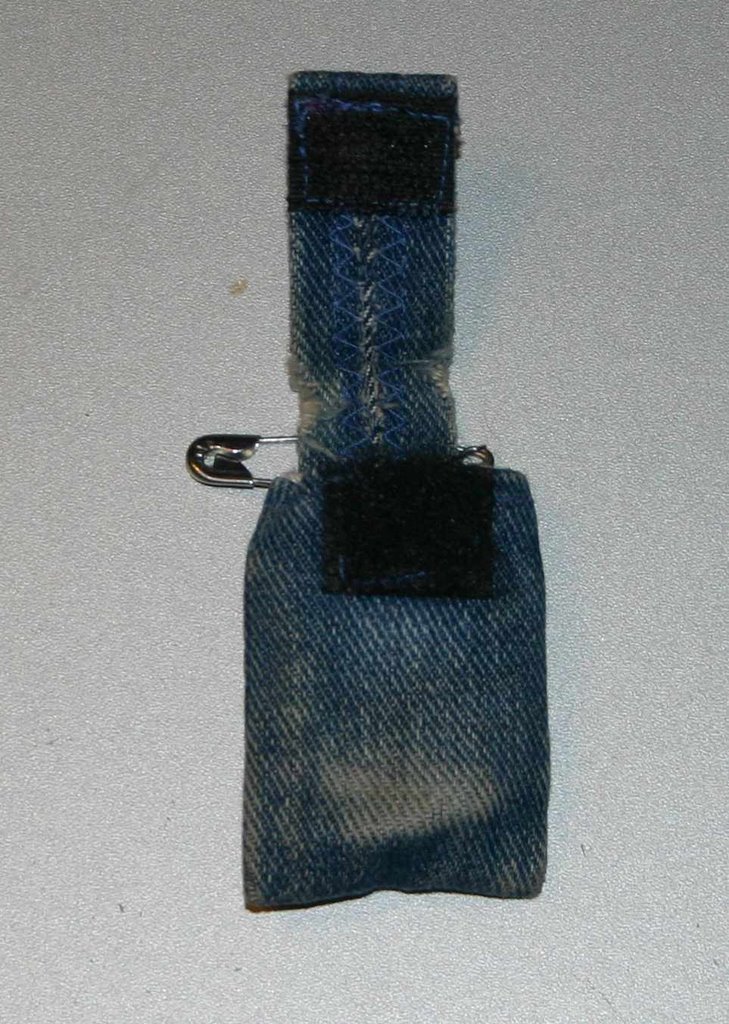
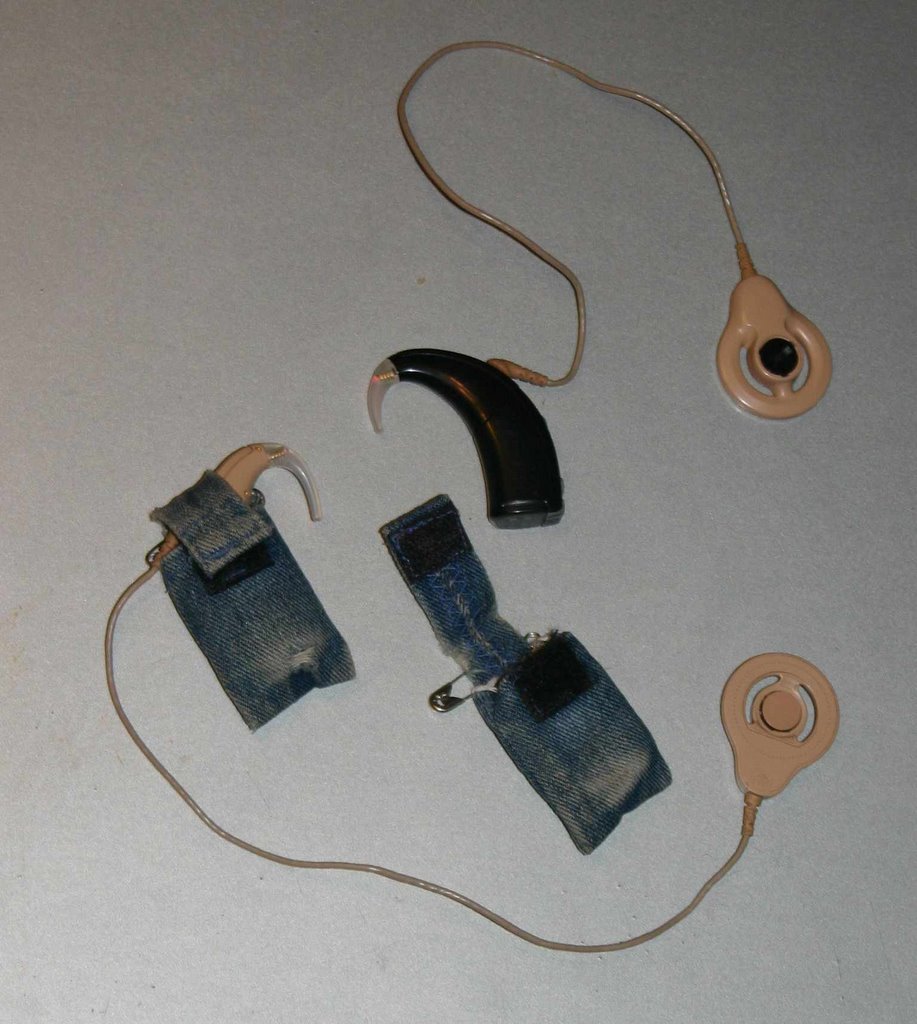
We very quickly chose to put them on her shoulders. At first I cut of fingers of a glove and attatched them with a safetypin. The providers of the Cochlear system - Medisan - quickly made sturdy bags, with a little flap that closed with velcro.


Another advantage of having the BTE's on the shoulder is that the BTE's don't show with the hair done up as shown here.... (Often we put the coil under the hair to make it harder to fall off.)


A couple of months ago, I sewed the safetypin on the bag. On the picture the flap of the bag goes through it. (Flap secures with velcro.) The microphone is sticking out.
As can be seen below, there is quite some wear on the bags, but for something used every day, 10-14 hours a day, they last quite long.

Some detail pictures of "our" system.... (Like with all pictures, just click to enlarge.)


(Here's some more info and comments in the blog regarding the BTE-bags.)

Friday, 15 September 2006

Overview of studies regarding bi-lateral CI

Here is the pdf:
http://www.bionicear.com/printables/reimbursement/BilateralCIBibliography-092006.pdf

Sunday, 15 May 2005

Benefits of bi-lateral

She once had one of her processors broken, and then she had CI on just 1 side. But this is already a big plus... she could still hear. Without bi-lateral CI, she would have been without sound.
In that time we noticed that with 1 CI she could not hear us as well. Noise was a real problem then, whereas with 2 CI's she has no problem following a conversation in the car or in the kitchen.
Also the sense of where sound comes from is helped with 2xCI. When hearing on 1 side, other senses and logic will determine where sound comes from. Bi-lateral CI will help a lot.

Regarding an additional operation.... I have seen children in Lottes school that got a second one after 1 to 2 years of CI. This means that in order to stimulate the new CI-side, the other side has to be disconnected. This can be really frustrating for these children. I'm really glad that Lotte got both sides at the same time, so we don't have that problem. But, realize that the additional benefit of a second CI is definitely there and I feel it is more than often suggested in articles and by the medical professionals.
BUT it is still small compared to the benefit of the first CI. THAT benefit is huge.

Friday, 1 October 2004

2004-10 (October) - Pre-Operation

The operation was scheduled in October 2004. 21 months after we discovered "officially" that she was deaf. She was 26 months old.

A preop/intake friday 1st of October, and the operation on the following monday, the 4th of October. We didn't stay in the hospital, but went home in between.


Finally - she was operated. And, as one of the first in Norway, she was offered bi-lateral Ci in 1 operation.... YES THANK YOU!!!!
We thought about that allready, and decided that in time we probably would do it.


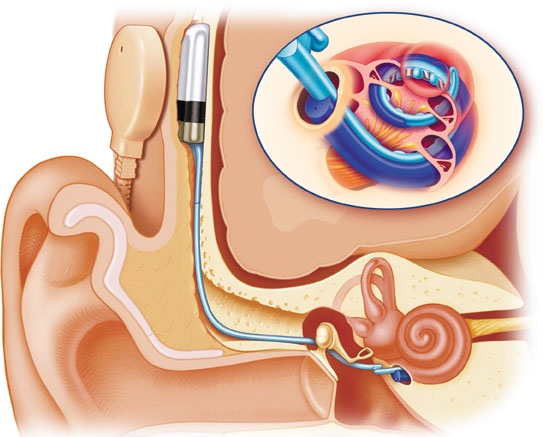
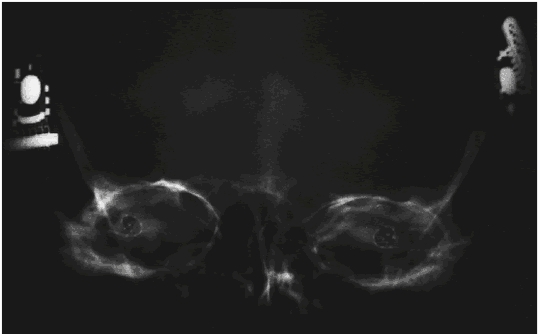
Here's a picture of an X-ray with bi-lateral CI. (Not Lotte) It gives a good impression about the size of the actual electrode..... (n.b. the big round circles are the eye-sockets. Behind there you can see the small spiral of the electrode.. )


Why would we want bi-lateral CI??

It's controversial because the idea is that the first CI is really a major improvement. The second one has less effect. The benefits are obviously that with bi-lateral CI one can hear where the sound comes from. Also, noisy environment is easier to handle because the brain can filter out a lot of the noise. This is obvious when listning through a phone. Noise on the other side is heared clearly while the person on the other side might not be bothered.
But in addition, when one CI fails, the other is still available.
Obviously, it will be two operations, but I don't believe it's double the risk. Another argument against might be that when CI is implanted in both ears, there is no option when new techniques arrive. (Stemcell for example)
But, if this would happen in 10 years, the auditory nerve would not have been used for 10 years, and who knows what the effect of that would be.

So, when we were offered bi-lateral CI in 1 operation, we gratefully accepted.

(Some) Milestones

  • 2013-08: Grade 6
  • 2012-08: Grade 5
  • 2011-08: Grade 4
  • 2011-03: BTE's on the ear
  • 2010-08: Grade 3
  • 2009-08: Grade 2
  • 2008-08: Mainstream School (6y. old)
  • 2006-10: All-hearing Kindergarten (4y. old)
  • 2004-11-22: CI activated (27 m. old)
  • 2004-10-04: Bi-lateral CI (26 m. old)
  • 2003-08: Deaf/HOH/CI Pre-school/"DEAF" Kindergarten (12m. old)
  • 2003-07: HA's fitted (11 m. old)
  • 2003-06: Diagnosed deaf. Start sign-language (10m. old)
  • 2002-11: Suspicion loss of hearing (4 m. old)
  • 2002-08: Born - A fierce LION
--- Google Analytics