Showing posts with label Articles. Show all posts

Monday, 30 September 2013

Loud in the morning..??

This came up on a Facebook group..
 People with CI experiencing loud noise when turning on the CI in the morning, after a long period of inactivity.

Lotte never had this problem.. (See this post from 2007.. Jeezz.. has it been that long....)

But for those who have this experience.. Here is a possible explanation..
Not that I really understand... out of my league. 

-------------------------------------------------------------------


 2013 Mar 27. doi: 10.1002/jbm.a.34719. [Epub ahead of print]

Dexamethasone released from cochlear implant coatings combined with a protein repellent hydrogel layer inhibits fibroblast proliferation.

Source

Department of Otolaryngology, Hannover Medical School, 30625, Hannover, Germany.

Abstract

The insertion of cochlear implants into the inner ear often causes inflammation and fibrosis inside the scala tympani and thus growth of fibrous tissue on the implant surface. This deposition leads to the loss of function in both electrical and laser-based implants. The design of this study was to realize fibroblast growth inhibition by dexamethasone (Dex) released from the base material of the implant [polydimethylsiloxane (PDMS)]. To prevent cell and protein adhesion, the PDMS was coated with a hydrogel layer [star-shaped polyethylene glycol prepolymer (sPEG)]. Drug release rates were studied over 3 months, and surface characterization was performed. It was observed that the hydrogel slightly smoothened the surface roughened by the Dex crystals. The hydrogel coating reduced and prolonged the release of the drug over several months. Unmodified, sPEG-coated, Dex-loaded, and Dex/sPEG-equipped PDMS filaments were cocultivated in vitro with fluorescent fibroblasts, analyzed by fluorescent microscopy, and quantified by cell counting. Compared to the unmodified PDMS, cell growth on all modified filaments was averagely 95% ±standard deviation (SD) less, while cell growth on the bottom of the culture dishes containing Dex-loaded filaments was reduced by 70% ±SD. Both, Dex and sPEG prevented direct cell growth on the filament surfaces, while drug delivery was maintained for the duration of several months. © 2013 Wiley Periodicals, Inc. J Biomed Mater Res Part A, 2013.
Copyright © 2013 Wiley Periodicals, Inc.

Wednesday, 17 October 2012

To Sign or not to Sign

First I want to say that communication is the most important goal...
With sign language or speech, or pen & paper....
As long as you establish communication..

Now.. read on...

http://jdsde.oxfordjournals.org/content/early/2012/05/09/deafed.ens018.short?rss=1

Language Planning for the 21st Century: Revisiting Bilingual Language Policy for Deaf Children
  1. Marc Marschark
    Abstract
For over 25 years in some countries and more recently in others, bilingual education involving sign language and the written/spoken vernacular has been considered an essential educational intervention for deaf children. With the recent growth in universal newborn hearing screening and technological advances such as digital hearing aids and cochlear implants, however, more deaf children than ever before have the potential for acquiring spoken language. As a result, the question arises as to the role of sign language and bilingual education for deaf children, particularly those who are very young. On the basis of recent research and fully recognizing the historical sensitivity of this issue, we suggest that language planning and language policy should be revisited in an effort to ensure that they are appropriate for the increasingly diverse population of deaf children.

Friday, 18 February 2011

Tuesday, 23 November 2010

Press release: Advanced Bionics Announces Voluntary Recall of the HiRes 90K Cochlear Implant

November 23, 2010

Device will be Recalled from the Market while the Company Works with the US Food & Drug Administration to Address the Issue

Valencia, CA, November 23, 2010 – Advanced Bionics (AB), a global leader in developing advanced cochlear implant systems, announced today that it has notified the US Food & Drug Administration (FDA) that it will voluntarily recall its HiRes 90K cochlear implant device and is retrieving all unimplanted devices in distribution. This action is being taken in response to two confirmed instances where the product experienced a malfunction requiring explantation. These recipients experienced severe pain, overly loud sounds and/or shocking sensations at 8-10 days after initial activation of their device.

AB is continuing to evaluate the root cause(s) of the problem and is working closely with the FDA to address their questions and concerns, and institute changes to the product to ensure that the HiRes 90K has the highest quality for patients who use the device. This voluntary action is being taken to ensure continued patient safety and product quality.  The risk of any significant adverse medical events appears to be remote at present.

About Advanced Bionics

AB is a global leader in developing one of the most advanced cochlear implant systems in the world. Founded in 1993 and partnered with Phonak under the Sonova Group in 2009, AB develops cutting-edge cochlear implant technology that restores hearing to the deaf.

With sales in over 50 countries, AB’s talented group of technologists and professionals from all over the world are driven to succeed, work with integrity, and stay firmly committed to quality.

###

If you have any questions regarding this press release, please contact an Advanced Bionics representative at 877-577-4628 (telephone) or live chat (online)  Monday – Friday 5:00 a.m. – 7:00 p.m. PST.
For media questions, contact:
mediaquestions@advancedbionics.com
Read the letter to recipients (PDF, 35 kb)

Monday, 7 December 2009

Friday, 11 September 2009

Bilateral CI..

Lots of information can be found here, at the Binaural Hearing and Speech Laboratory
May articles can be found, that can be used to argue for bi-lateral CI, if needed..

Sunday, 29 June 2008

Bi-lateral CI versus 1 CI - another "YES !"

More and more research is done with regard to bi-lateral CI.... and they are confirming what we already suspected.. it does make a significant difference.
Like I said before... the only experience we have had with Unilateral CI is when one of the processors failed.... well, the display wasn't readable.... and we had to send it in.... Send 1 in, so Lotte was still able to hear. That's when we experienced the difference....

So, we cannot compare - really, but we do see how well she hears in noisy environment (and with 3 children in the house... it's noisy at times) how her speech develops etc.....
We felt that bi-lateral CI had a lot to do with it....
..... guess it has.

Description of the article is below..... just to make sure a link suddenly turns up "empty...."
.... enjoy!

2 Bilateral Cochlear Implants Are Definitely Superior To 1

Main Category: Hearing / Deafness
Also Included In: Ear, Nose and Throat; Medical Devices
Article Date: 30 May 2008 - 5:00 PDT

A study of cochlear implant patients seen by Indiana University School of Medicine physicians is the first research to show evidence that cochlear implants in both ears significantly improves quality of life in patients with profound hearing loss and that the cost of the second implant is offset by its benefits.

The study, which appears in the May issue of the journal Otolaryngology-Head and Neck Surgery, found that improvements in factors that contribute to quality of life including such critical abilities as hearing in noisy environments, focusing on conversations, and speaking at an appropriate volume resulted when cochlear devices were implanted in both ears.

This study may have a significant impact for profoundly deaf individuals who hope to have their health insurance providers pay for bilateral rather than the standard single cochlear implant. The study authors found the benefits of the second implant outweighed the added cost of the second device.

"We didn't know that cognitive skills and emotional issues would so significantly improve with the implantation of a second cochlear device. In addition to the physiological improvements we saw in patients who had bilateral implants, we found that patients were able to function better in noisy environments and definitely felt better about themselves," said senior study author Richard Miyamoto, M.D., Arilla Spence DeVault Professor and chairman of the Department of Otolaryngology-Head and Neck Surgery.

Dr. Miyamoto is the immediate past president of the American Academy of Otolaryngology-Head and Neck Surgery. First author of the study is Bradford G. Bichey, M.D., MPH, a former research fellow and resident at the IU School of Medicine and currently an otolaryngologist in Marion, Ind.

"Profoundly deaf individuals who were born with hearing, their families, physicians, and health insurance providers now have the data they need," said Dr. Miyamoto. "There is definite improvement after one implant and there is a significant added bump in sound and speech perception after the second implant. Emotional well being improves. And we found a favorable cost utility analysis. Our hope is that with these findings more health insurance companies will cover the cost of bilateral implants and bring a superior quality of life to a large number of individuals."

Approximately 1.4 million American are deaf in both ears and experience significant impairment in communication with the hearing world according to the study authors. The IU School of Medicine cochlear program is one of the largest in the country. IU physicians have implanted more than 1,500 cochlear devices over the past quarter century at Indiana University Hospital and Riley Hospital for Children.

----------------------------
Article adapted by Medical News Today from original press release.
----------------------------

This study was funded by the IU School of Medicine's Department of Otolaryngology-Head and Neck Surgery.

Source: Cindy Fox Aisen
Indiana University

Friday, 30 May 2008

Bi-lateral CI - off course...

It makes me smile when research shows what people that experience bi-lateral CI them self, or with their child, already know.
Bi-lateral CI makes a huge difference compared to only 1.
I posted the article in here, as I don't know how long these articles remain available..
-----------------------------------------------------------------------------------------------

2 Bilateral Cochlear Implants Are Definitely Superior To 1

A study of cochlear implant patients seen by Indiana University School of Medicine physicians is the first research to show evidence that cochlear implants in both ears significantly improves quality of life in patients with profound hearing loss and that the cost of the second implant is offset by its benefits.

The study, which appears in the May issue of the journal Otolaryngology-Head and Neck Surgery, found that improvements in factors that contribute to quality of life including such critical abilities as hearing in noisy environments, focusing on conversations, and speaking at an appropriate volume resulted when cochlear devices were implanted in both ears.

This study may have a significant impact for profoundly deaf individuals who hope to have their health insurance providers pay for bilateral rather than the standard single cochlear implant. The study authors found the benefits of the second implant outweighed the added cost of the second device.

"We didn't know that cognitive skills and emotional issues would so significantly improve with the implantation of a second cochlear device. In addition to the physiological improvements we saw in patients who had bilateral implants, we found that patients were able to function better in noisy environments and definitely felt better about themselves," said senior study author Richard Miyamoto, M.D., Arilla Spence DeVault Professor and chairman of the Department of Otolaryngology-Head and Neck Surgery.

Dr. Miyamoto is the immediate past president of the American Academy of Otolaryngology-Head and Neck Surgery. First author of the study is Bradford G. Bichey, M.D., MPH, a former research fellow and resident at the IU School of Medicine and currently an otolaryngologist in Marion, Ind.

"Profoundly deaf individuals who were born with hearing, their families, physicians, and health insurance providers now have the data they need," said Dr. Miyamoto. "There is definite improvement after one implant and there is a significant added bump in sound and speech perception after the second implant. Emotional well being improves. And we found a favorable cost utility analysis. Our hope is that with these findings more health insurance companies will cover the cost of bilateral implants and bring a superior quality of life to a large number of individuals."

Approximately 1.4 million American are deaf in both ears and experience significant impairment in communication with the hearing world according to the study authors. The IU School of Medicine cochlear program is one of the largest in the country. IU physicians have implanted more than 1,500 cochlear devices over the past quarter century at Indiana University Hospital and Riley Hospital for Children.

----------------------------
Article adapted by Medical News Today from original press release.
----------------------------

This study was funded by the IU School of Medicine's Department of Otolaryngology-Head and Neck Surgery.

Source: Cindy Fox Aisen
Indiana University
-------------------------------------------------------------------------------------

Tuesday, 7 August 2007

Theory of Mind

Theory of mind is one of the things that is getting more and more attention with us.
Lotte does not have it yet. She would be on the phone and assumes the person on the other side can see what she sees. Or yesterday, she was in another room, actually, 1 floor up, and had to look for a yellow box. She kept asking "is it this one", "this one", assuming that we can see what she sees.

I found an article on Theory of Mind with a good explanation that I want to post here as well...

Note... I moved it to another post... click HERE.

Light CI

Friday, August 10, 2007


Making Deaf Ears Hear with Light


A laser-based approach could make cochlear implants, which currently use electrical signals, more effective.


By Michael Chorost


About 100,000 profoundly deaf people now hear with cochlear implants, which work by stimulating the auditory nerve with a string of electrodes implanted in the inner ear. While the devices enable many users to converse easily and use telephones, they still fall short of restoring normal hearing. Now scientists at Northwestern University are exploring whether laser-based implants could one day outperform today's electrical version.


The mammalian ear uses neural firing rates as one way of encoding sound. As part of a project funded by the National Institute for Deafness and Other Communication Disorders (NIDCD), Claus-Peter Richter and his colleagues at Northwestern have demonstrated that they can control firing rates in the auditory nerve of animals using infrared laser radiation. They are now trying to establish that it's safe to use for long periods of time and that it can manipulate neural firing rates with enough precision to send useful information to the brain.


With conventional cochlear implants, electrical signals spread in the wet, salty environment of the body, muddying the signal. That makes it difficult to trigger specific populations of nerves inside the cochlea. Further complicating matters, simultaneous pulses in different locations merge with each other, stimulating the cochlea everywhere instead of in the desired locations.


Engineers work around the problem by triggering only one or two of the 16 or 24 electrodes in the inner ear at a time. It's done so rapidly that the user has the illusion that all of the electrodes are firing, but the result is still a relatively crude simulation of normal hearing. To many cochlear implant users, voices sound mechanical and music sounds washed out.


An infrared laser, on the other hand, can be beamed at nerve fibers with pinpoint accuracy. Furthermore, the directional nature of laser light means that optical pulses in different places won't interfere with each other. The increased precision of neural stimulation would make voices and music sound more natural, and users would be able to converse in noisy environments more easily.


While it's not yet clear why infrared radiation can trigger activity in the auditory nerves, Richter hypothesizes that it heats the cells slightly, opening ion channels in the cell walls and sending an electrical signal down the length of the neuron.


A major question is whether it's safe to stimulate nerves in this way for long periods of time. So far, Richter and his colleagues have shown that auditory nerves in anesthetized gerbils can be stimulated with infrared laser radiation for up to six hours without damage. At present it's not feasible to run the tests for longer, but Richter is planning long-term studies in animals with permanently implanted devices.


The researchers are also figuring out how to precisely control neuron activity with lasers. The ear encodes pitch and loudness not just by firing nerves in particular places, but also by modifying the rate at which they fire. So far, Richter has shown that laser radiation can reliably make neurons fire up to 250 times per second, which is comparable to the rate at which early-model conventional cochlear implants drive neurons.


Human trials are years away, but there are several ways in which infrared technology might be used to build a working cochlear implant. One is to use fiber optics instead of electrodes in an array inserted inside the cochlea, somewhat similarly to the way conventional cochlear implants now use electrodes. Early trials of such a system might involve replacing one or two electrodes of a conventional implant with fiber optics to test their effect. Another is to put an optical fiber bundle in front of the cochlea's round window to stimulate auditory neurons without opening the cochlea. (The round window is a thin membrane in the cochlea that absorbs fluid displacement as sound waves travel through it.)


An even more futuristic possibility is to use gene therapy to make auditory neurons responsive to particular wavelengths of light. At MIT, Ed Boyden has been altering nerve cells' genes so that they fire when exposed to one wavelength of light and stop firing when exposed to another. According to Richter, this approach would require less power to activate cells, which might be safer in the long run. Of course, this approach carries all the caveats that typically accompany gene therapy and would require a way to precisely deliver gene therapy to the relevant auditory cells.


"If proven safe and efficacious, optical stimulation could open up ultra-high density stimulation interfaces for the peripheral nervous system," says Boyden. "The process of combining optics and neurons may also pave the way for many future innovations - moving beyond the ubiquitous electrode to new modalities of neural control."

Saturday, 12 May 2007

CI story by Frances Parsons - August 2002

(Frances M. Parsons is retired Associate Professor of History of Art and Coordinator of International Collections at Gallaudet University in Washington, DC)
---------------------------------------------------------------------------------------------

To: Sarah Wainscott, Director of Early Intervention and Preschool Programs

I came. I saw. I was conquered by the living evidence of how cochlear implant technology helps those toddlers at the River School. Words cannot describe how I felt when I finally visited the River School. I want to share this letter with anybody who wants to know about how cochlear implants benefit toddlers but are unable to get more information. The controversy about cochlear implants, especially in children, rages on with no let up. I have listened to pros and cons and met failures and successes. The most negative comment was "Those CI children at residential or day schools for the deaf could not speak!"

While sitting in waiting rooms .....Continue reading here..

Thursday, 19 April 2007

Cochlear Devices & the Deaf Community: Hearing Within


Have a look at this article..
Wish I had read this earlier... but then again... it's never too late...

Cochlear Devices & the Deaf Community: Hearing Within
by
Tammy Tillotson

.................

Thursday, 18 January 2007

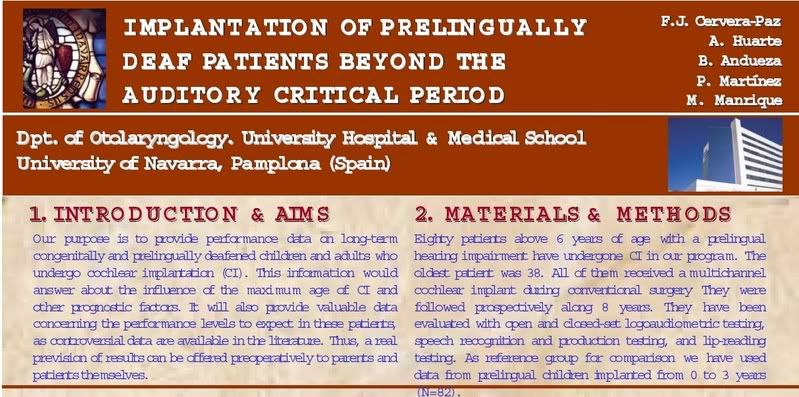
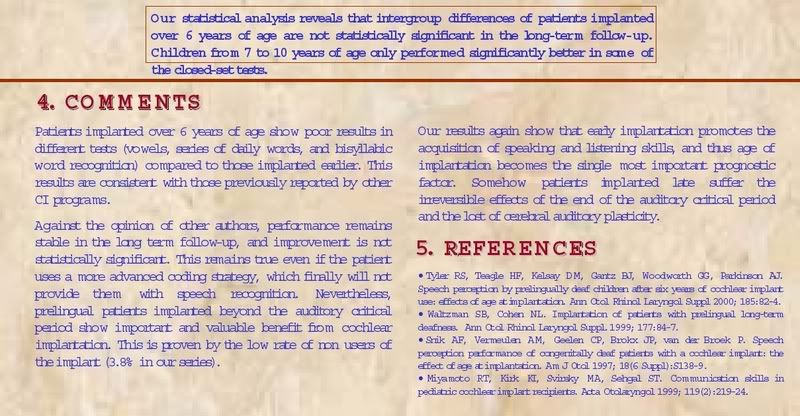
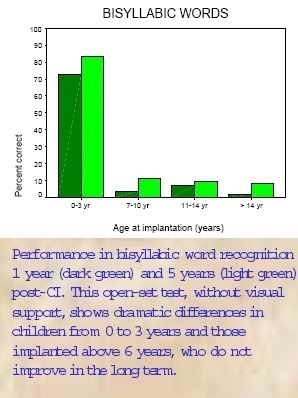
Age at implantation ...........

From here.....

Age at implantation and development of vocal and auditory preverbal skills in implanted deaf children

M.E. Taita, T.P. Nikolopoulosb, , and M.E. Lutmanc
a The Ear Foundation, Nottingham, United Kingdom
b Department of Otorhinolaryngology, Athens University, Greece
c Institute of Sound and Vibration Research, University of Southampton, United Kingdom
Received 13 September 2006; revised 16 December 2006; accepted 18 December 2006. Available online 18 January 2007.


Summary

Background

Preverbal vocal and auditory skills are essential precursors of spoken language development and they have been shown previously to predict later speech perception and production outcomes in young implanted deaf children.

Objectives

To assess the effect of age at implantation on the development of vocal and auditory preverbal skills in implanted children.

Methods

The study assessed 99 children, 33 in each of three groups (those implanted between 1 and 2 years; 2 and 3 years; and 3 and 4 years). Preverbal skills were measured in three areas: turn taking, autonomy and auditory awareness of spoken language, using the Tait video analysis method.

Results

The youngest implanted group made an exceptional progress outperforming in all measures the two other groups (p <>

Keywords: Language development; Speech perception; Cochlear implant; Prediction; Vocal; auditory; Communication; Preverbal; Observation; Interaction; Deaf; Children; Outcome

Friday, 15 September 2006

Overview of studies regarding bi-lateral CI

Here is the pdf:
http://www.bionicear.com/printables/reimbursement/BilateralCIBibliography-092006.pdf

Saturday, 1 April 2006

Intelligibility of conversational speech produced by children with cochlear implants

Intelligibility of conversational speech produced by children with cochlear implants
Peter Flipsen, Jr., and Lana G. Colvard Department of Audiology and Speech Pathology, University of Tennessee, 425 South Stadium Hall, Knoxville, TN 37996, United States Received 8 April 2005; revised 13 August 2005; accepted 8 November 2005. Available online 10 January 2006.

Abstract
The intelligibility of conversational speech produced by six children fitted with cochlear implants before age 3 years was measured longitudinally. Samples were obtained every 3 months during periods of 12–21 months. Intelligibility was measured using both an utterance-by-utterance approach and an approach to the sample as a whole. Statistically significant differences were observed between the two approaches, but the differences were all within the realm of measurement error. Findings indicated that intelligible speech emerges quite rapidly in these children. Conversational intelligibility appears to be superior to that reported in the literature for similar children who use hearing aids but not necessarily as good as in children with normal hearing. Both intelligibility measures were significantly correlated with chronological age, hearing age, and amount of implant use, but were most strongly correlated with chronological age.

Learning outcomes:
The reader will be able to
(1) describe some of the issues involved in measuring speech intelligibility in children with cochlear implants and
(2) describe the pattern of outcomes for the intelligibility of speech produced by children receiving cochlear implants before age 3 years.

Wednesday, 15 September 2004

Friday, 1 November 2002

Theory of Mind: Language and Cognition in Deaf Children

Theory of Mind: Language and Cognition in Deaf Children


by Brenda Schick, Jill de Villiers, Peter de Villiers, and Bob Hoffmeister


What does it mean to say that a child has a Theory of Mind?

As young children mature, they develop an understanding of themselves and other people as psychological beings who think, know, want, feel, and believe. They come to understand that what they think or believe may be different from what another person thinks and believes. They also learn that much of our behavior is motivated or caused by our knowledge and beliefs.

Simon’s Cake
An understanding of Theory of Mind might be best illustrated by an example, using a story.
Simon and his father made a cake together. But Simon wanted to go play and eat the cake later. So he put the cake in the cupboard. Then Simon left to play. The father thought that the icing on the cake might melt in the cupboard so he moved it to the refrigerator. Then the father left to go shopping. Later, Simon came home and he wanted to eat his cake. Where will Simon look for the cake?
You probably responded that Simon would look for the cake in the cupboard. He had put it there, and he didn’t know that his father had moved it. Your answer shows that you have a Theory of Mind. You can distinguish between what you know and the false belief, or misunderstanding, that Simon has.
Children around age 3, however, will answer this question incorrectly. They typically respond that the boy will look for the cake in the refrigerator, because that is where it is. At this age, children have difficulty distinguishing what they know from what others know. Children at this age are aware that people have thoughts, but they don’t realize that sometimes people’s thoughts and beliefs can be different from their own.

Major changes happen in the child’s understanding of other people’s minds around age 4. At this age, children can distinguish what they know from what others know, and they can correctly predict that a person’s behavior is dependent on what he thinks or knows, even when that belief is false. At about 4 years of age, a child can correctly predict that Simon would look in the cupboard, because that is where he left the cake.

Developmental psychologists call this a Theory of Mind because it shows that these children have an integrated set of concepts underlying their understanding of the mind. This is much the same as children’s "theories" in areas such as physics and biology. Children’s cognitive systems are not merely a collection of facts they have learned about the world. Rather, children develop an understanding that allows them to predict another person’s behavior based on what they know about that person’s thoughts and beliefs—just like you predicted that the boy would look for his cake in the cupboard. Like a scientific theory, a Theory of Mind allows us to interpret and predict other people’s actions by considering their thoughts, beliefs, desires, and emotions.

Theory of Mind and Deaf Children
Research has shown that children who are deaf have significant delay s in their understanding of a Theory of Mind. Previous investigators have speculated that the lack of access to conversations in the environment causes deaf children to miss important information about the world. But deaf children have some access to conversations, and, for the most part, they are socially competent, even when their language delays are severe. They do acquire a great deal of information about the world through visual means.

In addition, much of the research conducted on Theory of Mind skills in deaf children have relied solely on verbal tasks to assess their understanding. It is quite possible that deaf children have a Theory of Mind but don’t have sufficient language to understand the stories that are typically used to test them.

For very different reasons, children who have autism also have delays in developing a Theory of Mind. For the deaf child, the delay in acquiring a Theory of Mind is caused by lack of access to language, not by any fundamental cognitive problems. With the child with autism, the delays are a fundamental part of the disability, caused by cognitive differences in the child.

How Do Language Skills Relate to a Theory of Mind?
A recent investigation of Theory of Mind skills in children who are deaf (Language and Theory of Mind, funded by NIDCD to de Villiers, de Villiers, Schick, and Hoffmeister) attempted to determine whether deaf children were equally delayed in tasks that used language and those that didn’t. It also explored what aspects of the children’s development might be related to their understanding of the mind. The study included 176 children with a profound hearing loss representing three groups: 86 children being educated orally (53 with hearing aids, 33 with cochlear implants), 41 deaf children with hearing families learning American Sign Language (ASL), and 48 deaf children with deaf families exposed to ASL from birth. Unlike most previous studies, all children using ASL were tested by deaf adults who were native signers of ASL, and interpreters were not used.

Not surprisingly, the deaf children with deaf parents performed much like hearing children, while the children with hearing parents were significantly delayed in their understanding of a Theory of Mind. The results also show that the deaf children who were delayed in Theory of Mind were equally delayed in both the verbal tasks and the tasks that required minimal language. This means that the children lack some fundamental understanding of how the mind works regardless of whether the task requires language to understand it.

The study also revealed that the language skills in the deaf children were directly related to their Theory of Mind skills. However, it wasn’t the children’s general language skills but rather vocabulary skills and the specific ability to comprehend syntactic complements that predicted Theory of Mind skills. That is, if a child can understand sentences such as, "He thought his cake was in the cupboard," he is more likely to understand and predict behavior premised on a false belief, like that of the boy in the story. Children who had more advanced language skills were far more likely to pass the Theory of Mind tasks.

What this means is that the language delays that are typically observed in children who are deaf are causally related to delays in major aspects of cognitive development. Children who are not able to understand complex syntactic forms like complements have difficulty understanding how their own thoughts and beliefs may differ from those around them.

How Might Delays in Theory of Mind Development Affect Other Areas of Development?
There are several domains of development where Theory of Mind skills may be a prerequisite
or foundation for later development. First, it is very likely that Theory of Mind skills play a central role in children’ s understanding and production of narratives. Bruner distinguishes between the "landscape of action" and the "landscape of consciousness," both essential to narration. The fact that many deaf children appear to be delayed in their development of Theory of Mind skills may contribute to impoverished understanding of stories and so to their widely reported delays in reading skills. While many deaf children have difficulties with English grammar and vocabulary, these problems may not be the only cause of reading delays.

Research shows that even preschool storybooks have a great deal of content related to desires and beliefs of the characters. For example, Little Red Riding Hood has a false belief in that she thinks the wolf is her grandmother, but as readers, we know that the wolf is deceiving her and intends to eat her too. In order to appreciate the story, and its landscape of consciousness, a child must be able to see beyond the action and understand that Little Red Riding Hood doesn’t know what we know. Otherwise the story becomes a tale of action where Little Red Riding Hood takes food to her grandmother, but for some unexplainable reason, a wolf is there instead. Much of the sense of the story is lost.

Second, it is possible that Theory of Mind skills are important for the development of social interaction skills, particularly those skills required in schools. Astington and Pelletier argue that there may be a relation between children’s level of Theory of Mind development and their ability to learn by instruction and collaboration. They suggest that Theory of Mind understanding is also linked to the development of scientific thinking and critical thinking.
In short, education requires children to talk about mutual understandings and misunderstandings, to reflect on their own beliefs as well as others, and to shift perspectives when evidence suggests that another point of view is valid. All of these require Theory of Mind skills.

How Can We Help Children to Learn Theory of Mind Skills?
There are many ways that adults can likely facilitate a child’s acquisition of a Theory of Mind. Pretend play and role-playing allow children to escape from the reality of objects and roles. In order to do this, children may need to create separate cognitive representations for what is real and what is imaginary. Talking about past events also has been found to be related to Theory of Mind skills in children, probably because children need to discuss decontextualized events. As mentioned, even preschool books contain numerous references and opportunities to explore how the mind works. And life itself presents many situations where people forget where they put something, misunderstand and tease each other, imagine what could be, and discuss opinions and perspectives. Discussing these events with children will help them acquire both the language of the mind as well as concepts that underlie a mature Theory of Mind.

Finally, research on the development of Theory of Mind skills with children who have limited access to language shows us the powerful role language has in developing fundamental social and cognitive skills. While many professionals are quite aware of how important language is in our lives for communication and learning world knowledge, research on Theory of Mind shows that language provides the scaffolding to understand how minds work.
-----------------------------------------
Brenda Schick is an associate professor of speech, language, and hearing sciences at the University of Colorado at Boulder. She studies the development of ASL and the relationship between language and cognitive development in deaf children. Contact her by e-mail at Brenda.Schick@colorado.edu .

Jill de Villiers is Sophia and Austin Smith Professor of Psychology and Philosophy at Smith College. She is currently studying the impact of language acquisition on cognitive development as well as the development of new diagnostic tests for language assessment with particular reference to African American English. Contact her by e-mail at jdevil@science.smith.edu .

Peter de Villiers is Sophia and Austin Smith Professor of Psychology at Smith College. He is currently studying the interactions between language acquisition, cognitive development, and literacy in deaf children and pragmatics assessment. Contact him by e-mail at
PDEVILLI@science.smith.edu .

Robert Hoffmeister is the director of the Programs in Deaf Studies and the Center for the Study of Communication and the Deaf at Boston University. He is currently studying the relationship between learning, language development (ASL and English), and literacy in deaf children and the assessment of language in deaf children. Contact him by e-mail at
rhoff@ACS.BU.EDU .
-----------------------------------------
References
Astington, J. W. (1993). The child’s discovery of the mind. Cambridge, MA: Harvard University Press.
Astington, J., & Pelletier, J. (1996). The language of the mind: Its role in teaching and learning. In D. R. Olson & N. Torrance (Eds.), The handbook of education and human development: New models of learning, teaching, and schooling (pp. 593–619). Cambridge, MA: Blackwell Publishers Ltd.
Bruner, J. (1990). Acts of meaning. Cambridge, MA: Harvard University Press.
Bruner, J. (1999). The intentionality of referring. In P. D. Zelazo, J. W. Astington, & D. R. Olson (Eds.), Developing theories of intention (pp. 329–340). Mahwah, NJ: Lawrence Erlbaum Associates.
de Villiers, J. G., & de Villiers, P. (2000). Linguistic determinism and the understanding of false beliefs. In P. Mitchell & K. Riggs (Eds.), Children’s reasoning and the mind (pp. 189–226). Hove, UK: Psychology Press.
de Villiers, P., de Villiers, J., Schick, B., & Hoffmeister, R. (2000). Theory of mind development in signing and non-signing Deaf children: The impact of sign language on social-cognition. Paper presented at the Seventh International Conference on Theoretical Issues in Sign Language Research, Amsterdam, The Netherlands.
Gardner, H. (1991). The unschooled mind. New York: Basic Books.
Nelson, K. (1996). Language in cognitive development: The emergence of the mediated mind. New York: Cambridge University Press.
Peterson, C., & Siegal, M. (1999). Representing inner worlds: Theory of mind in autistic, deaf, and normal hearing children. Psychological Science, 10(2), 126–129.
Russell, P. A., Hosie, J. A., Gray, C. D., Scott, C., Hunter, N., Banks, J. S., & Macaulay, M. C. (1998). The development of theory of mind in deaf children. Journal of Child Psychology & Psychiatry & Allied Disciplines, 39(6), 903–910.
Schick, B., de Villiers, P., de Villiers, J., & Hoffmeister, R. (2001). Language, literacy, and Theory of Mind in deaf children: What we know and what it means. Presented at the annual meeting of the American Speech-Language-Hearing Association, New Orleans, LA.
Schick, B., Hoffmeister, R., de Villiers, P., & de Villiers, J. (2000). American Sign Language and Theory of Mind in Deaf children with Deaf or hearing parents. Paper presented at the Seventh International Conference on Theoretical Issues in Sign Language Research, Amsterdam, The Netherlands.

(Some) Milestones

  • 2013-08: Grade 6
  • 2012-08: Grade 5
  • 2011-08: Grade 4
  • 2011-03: BTE's on the ear
  • 2010-08: Grade 3
  • 2009-08: Grade 2
  • 2008-08: Mainstream School (6y. old)
  • 2006-10: All-hearing Kindergarten (4y. old)
  • 2004-11-22: CI activated (27 m. old)
  • 2004-10-04: Bi-lateral CI (26 m. old)
  • 2003-08: Deaf/HOH/CI Pre-school/"DEAF" Kindergarten (12m. old)
  • 2003-07: HA's fitted (11 m. old)
  • 2003-06: Diagnosed deaf. Start sign-language (10m. old)
  • 2002-11: Suspicion loss of hearing (4 m. old)
  • 2002-08: Born - A fierce LION
--- Google Analytics