Showing posts with label Sound. Show all posts

Thursday, 24 October 2013

BlimE Song.. - "Join Us"

Weeks of practicing for a dance with all other schools in Norway.
Finding the son.. practicing the dance.... excellent.


And in the end it came all together to the day the whole school performed it... All over Norway.
Great initiative..


Thursday, 10 October 2013

Swimming with both CI's on...

It's not easy to get them right, but when they finally sit... they sit...
After not wanting any CI under the swimming cap (pre-summer) she agreed (after we forced her) that hearing what the trainers said was kind of handy. So.. 1 CI was accepted. Then she came up with the idea of 2 CI's.. Who are we to disagree with that...

Anyway... We found out that when we first localise where the spool needs to go above the cap, then put the spool there - under the cap, and then push the processors under the cap (on the ear is really awkward..) it works well..

So.. Bilateral Swimming....


Tuesday, 20 November 2012

Touching Sound

Found this picture again
Love it how this little girl touches sound..

Thursday, 11 October 2012

Priceless - Bubbles

Lotte doesn't discover many new sounds, or at least she's hardly surprised when she hears a new sound..


Today she discovered a new one that did surprise her. The sound of bubbles coming from her coke!!

At first she said "what's that.?" when she poured her coke.
Then we let her listen with her ear on top of the glass with coke.
As she listened, a big grin came on her face..

Priceless.!!


Update:
And of course Lotte wants it om the blog....

Friday, 19 November 2010

Did you hear that?

OK...
just have to put this down for the record...


Early morning.. Lotte just out bed, (but been awake for a while) and is sitting on the toilet.. doing a (powerful) #1. No CI on the ears / shoulders... so completely deaf....
Lotte's mother is there as well, hearing how she is working... Suddenly a big "splash..!!".
Lotte triumphantly looks up to her mom and says... "Did you hear that..!" :-)


(Update: more a "plong" than a "splash"..)


What's going on inside that lovely girl's head.. ??? LOL
(Probably this..)

Thursday, 11 November 2010

Speaking & hearing & understanding for all..

Trying FM wasn't a big success. (See other posts..) The school had some meeting with the councel and got themself informed about the possibilities for making Lottes learningenvironment better.
One of the conclusions was that having a sound-system in the classroom would be of great benefit to Lotte, and the rest of the class.

So, last week, th school has installed a sound-system in Lotte's classroom. Speakers on the wall, a microphone for the teacher to have around her/his neck, and microphones for all the children.. (well, 1 for every 2 children) so that from now on everyone should be abe to hear and understand everyone else.
We haven't heard yet about how it's working. We understood that on the first day it was available, the teacher used the microphone, but not the kids. But all the kids liked it, and I'm sure they are all looking forward to using the microphone.
It's not just for Lotte, even though she's the reason it's installed. The other children will benefit from better sound, AND they will be trained in speaking in turns. 
Will keep you all informed....

Have a look here... (Norwegian)


Friday, 8 October 2010

Homework...

Yesterday a great moment..
Lotte needed to finish some homework; writing down 30 (Norwegian) words that they have been using the last 3 weeks. We say them out loud, she needs to listen to them, and then write them down.
Lotte's mother is in Holland, visiting grandma...
Just before we started the homework, I thought to let Lotte talk to her mother via Google-Chat-Video....

This means OK image with bad sound from the Acer mini-laptop. (Aspire-One)
But Lotte seemed to have no problems with understanding the other side, and before we knew it, her mother was saying the words, and Lotte wrote them down on the computer in the chat-line......
This was so wonderful.... Some of the words are pretty close - sound-wise - but Lotte understood them well.. in fact.. she made only one mistake....

Imagine.... our deaf daughter here in Norway, listening to her mother who's in Holland saying the words she needs to write down, and then Lotte listning, then writing them on the computer in Norway... being displayed in Holland.
Who could have thought that 10 years ago....
All this technology helping Lotte to make the best of the possibilities life has to offer....

Monday, 15 February 2010

Yes... I can hear that. :-)

Saterday morning... I walk down the stairs into the living room... The girls, Lotte and Sanne are watching TV, around the corner.. they can't see me coming down..

Then, a little voice say's... "Good morning daddy.. :-) "
Lotte gives me a big smile when I turn the corner...
"I could hear it was you.. :-)  "

How's that for CI technology... Hearing someone coming down the stairs, and even hearing who it is..

So, next time you hear a simulation of "how a CI sounds".... don't believe it..
Because - there's one thing those programs can't simulate...
The brain...

Thursday, 28 January 2010

FM equipment..

We're going to experiment with Lotte's FM equipment.
We have had it for a while, but since she didn't have problems in the classroom, we decided to wait a bit... That's.. until now. Time to experiment.

On my search for some explanations about the equipment I came across this webside..


Nice site to give an idea about using FM in a classroom with noise.
Have a try... . Adjust the parameters. For example - distance to the teacher... and the noise. Then turn on the FM-equipment.... 

Impressive demo... Not sure how real the situation is... perhaps readers that have CI and use FM may confirm that it's a good demonstration....

p.s.
Some linke (Thanks Dan..)
Acoustics: http://www.lenardaudio.com/education/04_acoustics.html
Info: http://www.babyhearing.org/HearingAmplification/AidChoices/FMSystem.asp
Question: http://forums.about.com/n/pfx/forum.aspx?tsn=1&nav=messages&webtag=ab-deafness&tid=4918
Acoustics in classroom: http://asa.aip.org/classroom/booklet.html

Monday, 4 January 2010

Hearing and speaking....

Wonderful "happening" this morning..
Woke up late, and were listening to Lotte playing with Lego outside our bedroom. Lotte would have been up since 7:30, and she comes to us to have the batteries (rechargeable) put in her processors and have the pouches pinned on her clothes.
So... listening we were wondering if she had a friend with her, since she was engaged in role-play. There was definitely an alternate voice, and it sounded like one of her friends from down the road was with her.. So, Lotte's mum got up, dressed and had a look, only to find Lotte engaged in a wonderful play.. just by herself.

Many times, people will talk about how CI would sound completely different compared to normal hearing... and fine, who can argue with that, except that here's a girl that is doing two different characters, in two different voices, communicating in a make-believe conversation...
Pretty amazing, and far, far away from the simulations you can find on the net.
The mind is an amazing tool, and apparently is able to discriminate sounds very well... even with "only" 22 or 24 electrodes..

Friday, 11 December 2009

Good basic info regarding Bi-lateral CI....

From a thesis by Carol A. Sammeth, Ph.D, CCC-A

Please be careful that the statements selected are representative of the paper's overall conclusions.  Also, the part posted is only a piece of a longer work. (Full pdf here..)
------------------------------------------------------
BRIEF REVIEW OF BENEFITS OF TWO-EARED INPUT


The Psychoacoustic Literature
There is a fairly voluminous literature in psychoacoustics (hearing science) illustrating the benefits in normal hearing persons of having two-eared rather than one-eared input. When hearing loss disrupts the ability of the brain to process binaural inputs, whether due to large differences in the degree of loss between the ears, or a failure to provide amplification or a cochlear implant to one impaired ear, these benefits can be severely degraded or lost. There are three primary effects ascribed to binaural listening: the head shadow effect, the binaural summation effect, and the binaural squelch effect (e.g. Durlach & Colburn, 1978), producing benefits that range from improved speech recognition in noise, to the ability to localize the direction of a sound, to more “natural” perception. The following briefly describes the key benefits of binaural functioning.

Head Shadow Effect
When speech and noise come from different directions (i.e. are spatially separated, as typically occurs in the real world), there is always a more favorable signal-to-noise ratio (SNR) at one ear than at the other because of the head shadow effect and different sound distances to the ears. The head shadow effect is primarily seen in frequencies higher than 1500 Hz (e.g. Shaw, 1974), with the amount of attenuation of sounds from the opposite side of the head dependent on frequency but ranging from about 7 dB in the speech range up to 20 dB or more at the highest frequencies. If both ears are participatory, the ear with the most favorable SNR is always available so that the patient can selectively attend to this ear. This is compared to the unfavorable situation where only the ear with the poorer SNR is functional. Persons with unilateral hearing loss can become very frustrated when people are talking on both sides of them because they must constantly turn their “good ear” to whomever they want to hear best at the time, and then they miss sounds on the deaf ear side.

As will be shown later in this paper, a primary benefit of bilateral cochlear implants appears to be related to the beneficial aspects of hearing from both sides, and always having the ear with the more favorable SNR available. This is generally tested with speech from a frontal speaker and noise from a side speaker - - when the second ear is added that is contralateral to (opposite side of) the noise source, performance benefit comes primarily from the head shadow effect. Note, however, that there is discrepancy across the published studies in how to quantify the head shadow effect, with some researchers merely examining differences in scores with sound ipsilateral versus contralateral to a unilateral ear under test, and others comparing the score for listening with bilateral inputs to that for unilateral listening with the noise presented ipsilateral to the ear under test.

Binaural Summation & Redundancy
Sounds that are presented to both ears rather than just one are perceived as louder due to binaural summation of the information received at each ear. In fact, the threshold of hearing is known to improve by about 3 dB for binaural versus monaural presentation to normal ears, resulting in a doubling of perceptual loudness and improved sensitivity to fine differences in the intensity and frequency domains. This latter effect is sometimes referred to as binaural redundancy, and it is believed that it may translate into improved speech perception scores. When listening to speech with only one ear in a difficult listening situation or with one ear with greater sensorineural hearing impairment than the other, there is a loss of the redundancy in cues across the ears that may reduce performance.

The benefit of the binaural redundancy aspect of bilateral inputs is typically tested by presenting speech alone or having speech and noise emanate from the same loudspeaker frontally - - when the second ear is added, benefit is possible through redundancies or overlaps in representation at the two ears. In a normal hearing ear, this effect produces about a 1 to 2 dB improvement in SNR (Bronkhorst & Plomp, 1988). At this time, there is only limited evidence for true binaural redundancy effects on speech perception results in the
bilateral cochlear implant literature reviewed herein. This effect is probably not stronger either because such subtle cues are not able to be utilized by ears that have severe to profound hearing loss, or simply because the signal processing available in today’s cochlear implants (with two implants processing independently) does not adequately maintain these interaural cues.

Binaural loudness summation has been shown to occur, however, and is a potential confounding factor in comparing across studies. While most researchers have adjusted the loudness of the implant processing for binaural presentation versus monaural presentation (and made sure loudness is reasonably balanced across the ears), some have not. In a clinical bilateral implant fitting, it would generally be presumed that loudness would be adjusted so that the patient’s overall loudness comfort level is reasonable, and thus any purely binaural summation effects would be reduced or negated for bilateral listening compared to a previous unilateral implant.

Binaural Squelch/Unmasking
A person with only one functioning ear can usually understand conversation well when listening in a quiet environment, as long as the sounds of speech are made loud enough. However, even a normal hearing person who is listening in high levels of background noise can find speech understanding to be difficult in an adverse listening situation (consider, for example, competing conversations with multiple persons seated at a long table in a very high noise level restaurant). This occurs partly because of direct masking and partly because of upward spread of masking on the basilar membrane of the cochlea (whereby low-frequency sounds have a greater impact on reducing perception of higher-frequency sounds than vice versa). Speech recognition in such noisy environments is even harder for a person with sensorineural hearing loss both because of the inherent distortion and loss of normal nonlinearities introduced by cochlear damage, and because these patients show even greater amounts of upward spread of masking effects than do normal ears.

Fortunately, the auditory nervous system is wired to help in noisy situations as long as there is functional input from both ears - - that is, the auditory system and brain can combine information from both ears so that there is a better central representation than would be had with only information from one ear (e.g. Zurek, 1993). This effect, commonly referred to as binaural squelch (but also sometimes called binaural unmasking), results from the brainstem nuclei processing timing, amplitude, and spectral differences between the ears to provide a clearer separation of the speech and noise signals. The squelch effect takes advantage of the spatial separation of the signal source and the noise source(s) and the differences in time and intensity that these create at each ear. This is generally tested with speech from a front speaker and noise from a side speaker - - when the second ear is added that is ipsilateral to (same side as) the noise source, any benefit comes from the binaural squelch effect. There is some limited evidence of improved speech understanding in noise in bilateral cochlear implant patients due to binaural squelch effects, although the effect is not seen across all bilateral implant users or studies, and is not as large as the head shadow effect.

Note that binaural summation and squelch are signs of the ability of the auditory nervous system to integrate, fuse, and use information from the two ears. In contrast, the head shadow effect merely results from the physical attenuation of sound across the head and does not require central nervous system integration - - This does not negate the fact, however, that the head shadow effect is a substantial factor in everyday performance for those listeners with unilateral versus bilateral devices.

Localization
Finally, perhaps the most well-known practical binaural benefit is the ability to localize (i.e. determine the direction that a sound is coming from). This function is dependent on auditory Bimodal Devices and Bilateral CIs, page 9 system perception of interaural (between ear) differences in time, intensity, and phase (e.g. Yost & Dye, 1997). Localization ability can be a safety consideration. For example, when crossing a busy street, it is important to know the direction that a car is coming from. Persons with significant unilateral hearing impairment can also attest to the frustration of hearing their name spoken but not knowing which direction to turn in order to find the person calling them.

Research to date has focused on localization of sound sources in the horizontal azimuth, but keep in mind that it is also possible for a listener to differentiate sound sources in the vertical plane (by elevation) and in terms of the distance from the listener. It is well known that interaural timing differences provide the information necessary to locate the direction of low frequency sounds - - specifically, those less than about 1500 Hz. For sounds that are higher in frequency, the main cue for horizontal plane localization is the interaural intensity difference that occurs because of the head shadow effect. In addition, head and pinna shadow effects,
pinna filtering effects, and torso absorption properties can all contribute to spectral differences that can be particularly helpful in determining elevation of a sound. For a listener with only one functional ear, there are very few cues to assist in sound localization although some rudimentary localization ability can still exist. The literature on bilateral cochlear implants provides significant and substantial evidence that localization abilities are enhanced with the use of both ears versus just one.

Sunday, 5 October 2008

Music school

"I want to go to the music-school"... Lotte said..
My wife wasn't sure she heard it correctly, so ask Lotte what she said..
"I want to go to the music-school" ..not so loud and clear. (We are working on talking with a soft voice..)
Many of the children in her class are signed up for this. Playing with instruments, singing. All in order to create a basis for music.
Still not sure if Lotte understood what happened in the music-class, my wife asked her "What do they do ther.?.
"Singing" Lotte replied. She is totally aware what's happening there, and wants to be part of it. (We're not really surprised.)

Of course she will go there. She loves singing and playing on her piano. She sees her brother playing guitar and her sister sings in a choir. Of course she must follow.

We never signed her up because we wanted to see how she would handle the transition from kindergarten to school.
As said before, that went without a problem. (Seems it happened overnight..) so there's no reason to keep her away from the music class. Just have to prepare the music-teacher about Lotte.)

So, another milestone. Our deaf daughter wants to make music.
And it is very touching to see her sing along with the music. It goes too fast for her most of the times, but now and again she suddenly hits the right note.
It's wonderful....
Still... lots of work to do in that area.!..

Friday, 14 March 2008

Take off the ears!!

It's been a while since the last update. Not that nothing is happening, on the contrary, it's just that there are soo many little things, that it looks as if nothing is happening... until one looks back.

As readers of the blog might know, Lotte does not have her CI on when she's asleep. After the bedtime story, she takes them off herself in order to indicate that she's going to sleep.
In the morning.... early, as she has no problems waking up around 6:00, she starts the day completely deaf.... Only when the rest of the house starts waking up, the CI has to go on.
Even without CI she understands a lot.
Just some weeks ago, she came down after we put her to bed, went to her mother, asked a question (remember, no CI...) with normal voice, and "red" her mothers answer.
We thought about how Lotte probably still "hears" the sounds of the voices. Even though she cannot hear, her brain might very well create the sounds that are appropriate.
I read about this once, where someone thought he was HOH, until when he was talking with his brother. Everything sounded normal to this person, until his brother put his hand in front of his mouth...
Suddenly, all sound stopped. Without being able to read lips, the brain was not able to create sound!

This morning, Lotte had been playing since 6:06.... one remembers the hour one is disturbed from a good night sleep. She played in her room and the attic and around 7:30 the rest of the family got up and started doing their things. Lotte was so occupied with playing, she never requested the CI's.

Then it was time for her to get dressed. So, she went to her room, got her clothes, and came to me... turning around in order to have me take off her CI's....

However.... she was not wearing CI, but she didn't realise it. So she demanded again that I would take off her CI.... I did nothing, and she became frustrated... "Take off the ears!!" she said...
Then her mother came in, picked up the CI's hanging on the wall, and showed her the CI's.... and only then Lotte realised that she did not have them on.
We all had a great laugh about it, Lotte included....

It's wonderful to see how she is totally at ease with being deaf, but this time we got a little peak in her world, where, even when sound is off, it still goes on in her head....

Thursday, 12 April 2007

Self-help.... with CI....

When Lotte started with her CI, it was obvious that even though she liked wearing them, putting them on was not a necessity. She could be walking around without sound, not being bothered about the silence. After all, it's part of her life....

Gradually, she became more aware of this, and she would be quick to put them on..
(I recall an episode where she had a tantrum, let herself fall on the floor, crying, and when the CI came off, she made sure it was put on again.... I guess part of crying is hearing yourself...) But she could still go around a while with dead batteries without telling us. We use to normally change them every 3 days. But it seemed that if the sound was gone, and the coils were still there.... Ah, well, she just continued in silence....

About a month ago the next phase started. She notices when the batteries are dead. She'll alert us, and we will change them. Not long after that, she showed that she couldn't wait for us... ....
I was sitting at the table, and Lotte indicated that the "ears" didn't work. I wanted to check the display, and told her to come to me. First with my voice - she refused..., then voice and sign, but she had still no intention of coming to me. She wanted to go upstairs and get the batteries herself.... No time to loose!!!

I love to see her enjoying the CI, enjoying the sounds around her. And I also enjoy how she is perfectly comfortable without the sound. Sure, during the day, she wants to hear and will insist on new batteries. There's too much to miss I guess.
But when we take her to bed, take off the CI (pinned to her cloths on her shoulder..) she continues as if nothing happened.
And I guess she's lucky that she has absolutely no negative experience with putting them on either. She just does it and is up and running...

Monday, 12 March 2007

CI - in the morning... is it working ??

(btw.. Lotte doesn't have this at all. No blinking whatsoever. Just "plug and play"...)

A nice tip on CiCircle - the Yahoo group..

OK, I just watched this short film that I think might be the best film about cochlear implants ever.
It is very funny and it will explain why some kids don't like to put their processors on in the morning. Or maybe I just have a strange sense of humor.
(It's also a great demo on how to fix an Advanced Bionics T-mic.)

Warning: the lyricsof the background music are probably not child-appropriate.
http://www.medhumanities.org/2007/03/equilibrium_sho.html

L


It is a great movie and the powerful "hookup" will possibly be valid for some CI-users.
Lotte is not affected like this when she puts her CI's on in the morning. Not a blink!!

But I like the way deafness is shown; just the heartbeat is "felt", no other sounds. How the hearing is turned on, and the tap that was not heard before can now be heard.
How only part of the song is understood with only 1 CI, and when the other one comes on, there's definitely something wrong.
Love how the repair is visualized, and how in the end, the guy can hear those beautiful words... "I love you!"

Have a look, and enjoy !!

(YouTube version below.)

Monday, 22 January 2007

Good morning - New Batteries...

Yesterday, sunday, trying to sleep in... she came to our bed with the CI's already on. This we allready did a couple of hours before.. this way, Lotte can play with her brother and sister, we continue to get some more sleep...

However, suddenly she came into the room. She had noticed herself that the batteries were empty, so she brought us a new battery-pack (she knows where they are..) and told us to change them.

How's that for problem-solving cababilities.....!!

Good Morning... Change batteries.... NOW!!

Wonderful !!

Thursday, 18 January 2007

Hard-of-hearing or Language-deprived ?

A thought that crossed my mind - actually, it didn't cross, it got caught, is that the way we look at children with CI might be wrong. Wrong in the sense of what kind of support we give compared to the support they need.

Historically, CI's were the next step from HA's. And with that, CI's are many times still regarded as such. A hearing aid. Working in a different way, but still, an aid to hear.
People with CI are therefore still regarded as Hard-of-hearing since "obviously" they use an aid to hear.

This might very well be true in many cases, but a new generation CI-users is emerging. Children that are implanted (often on two sides) before the age of three that do not conciously grow up deaf. CI is giving them sound that enables them to speak and understand language.
The "problem" these children have is not lack of hearing. They hear very soft sounds, they understand and reply with whisper. In that sence they are not hearing impaired. (Keep in mind... I have Lotte in mind. I know results can be different.)

They ARE however behind in language and therefore cognitive thinking. The older the child, (1, 2, 3 years old) the more this is true. This is where the supportsystem should focus! On gaining on the lost language. Because language defines us.

Obviously, the situation depends from child to child. 1 CI will make undrestanding in noisy environment much more difficult, and with that, there is a hearing impairement. But think of children that do well with bi-lateral CI. These children need language, speech and above all, comprehension.

Example,
Lotte is now in an all-hearing kindergarten, and with the language she has, she is behind compared to other 4-year olds. (We are not worried about that. She only has two years of sound, so obviously she's behind - and catching up nicely...) She is not able to master communication with children that otherwise would be her "equal" because the others do not understand her. The result is that she will look for other children that either ar younger but at her speech level, or children that are more fysical that communicative. (e.g. boys, playing outside... where screaming and actions goes a long way.)
Focus should be on making sure Lotte is understand. (And this is being done in her kindergarden..)

It seems that for the children, focus is actually on communication and speech.
But what about the parents...
In Norway, the parents are offered sign-laguage classes free of charge. BUT, the focus is only on that. Sign. WE, Lotte's parents, do not have a need for that. Lotte does not use it any more. We need information in speech and language development. How does it work. What are the milestones... What to look for, how to play, what to do, what NOT to do.
BUT since children with CI are still looked at through "DEAF" glasses instead of "Language deprived" glasses, that support is not available. Only "DEAF" therefore "Sign" support...

How is that elsewhere..??
Is the support sysem different.
Like, AV-therapy. It's not available here in Norway, but I have a feeling that there the focus is on educating the parent.... Correction, it's not available where we live..
Anyway... have to do some more research on it.

Wednesday, 17 January 2007

Lotte's Morning Ritual....

The mornings have become a bit better. (Have a look here for the previous experience.)
Lotte is still waking up very early, but has gotten in the rhythm of going to the toilet to pee, then back to her room and starts playing.
During this time she will not be wearing her CI's, and it is therefore amazing that she still talks to herself. In a normal voice, she will babble along while playing.
After some time she will go back to the toilet for the bigger job. This will result in a loud cry "Daddy !! Poep" which is OK since not complying to this "distress signal" might result in additional cleaning.....
After this, she will go back to her room and continue playing. Still without her CI.
In addition, she will put on her clothes....


When we all need to get up, we go to her as well, say good morning... and that is for her the sign to put on the CI.
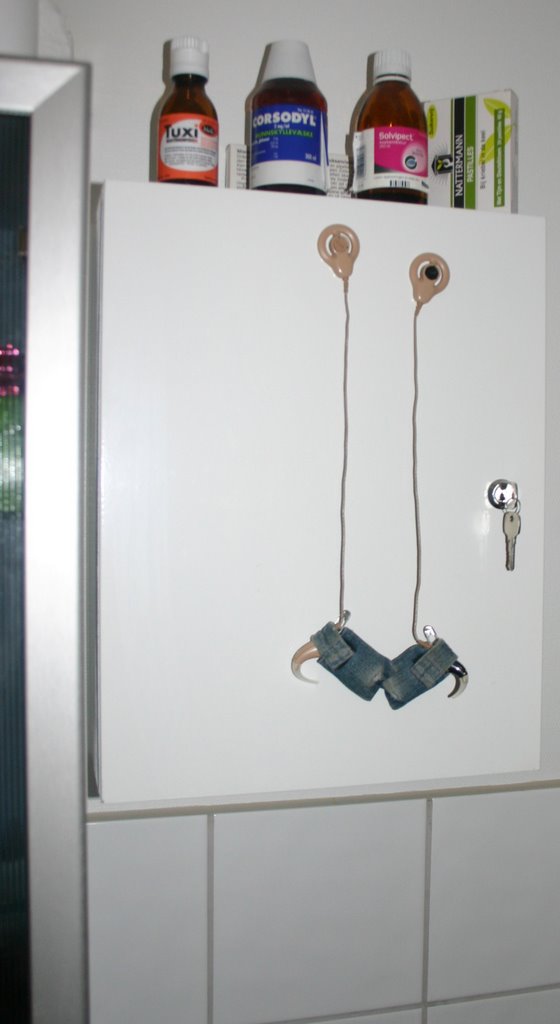
It's wonderful to watch how she goes straight for the CI's. They are hanging on the medicine cabinet, and she can reach it with the help of a little chair.

But interestingly, she will not take them before it's clear that people are finished sleeping.
We made that very clear, that when everybody is sleeping, she has to be quiet and remain in her room. Not wearing CI's is appearently also part of it.

Today, she started playing outside her room. I went out of bed... she didn't see me (Nor did she hear me) so I turned the light off/on to alert her.
I looked at her, pointed to her room and she said "Sorry Daddy!!" and went to her room.... turned the light on (she had turned it off, showing her intention not to return :-)

Ah... so cute!!!

Tuesday, 2 January 2007

Cochlear Implants - A Technical and Personal Account

A very interesting overview of hearing for those who are interested.
Got it on AllDeaf from Boult. Thanks !!


Install the files as instructed and be amazed. It's a big file (50 Mbyte), but worth the waiting...

------------------(Below the original post with links) -----------------------------------------


Cloggy and et al, You may be interested in viewing this PP slides..
It is windows only... Ian Shipsey's Colloquium "Cochlear Implants a Technical and
Personal Account" (he has CI, a Medel Combi as per his page;
Ian Shipsey's Web Page )
Go to
IanShipsey's Colloquium "Cochlear Implants a Technical and Personal
Account"
to read direction to view his Colloquium via powerpoint.
For information about his Colloquium;
Professor Ian Shipsey

(as for mac user, just click that says "View other files available for download" and get all files except for those ".exe" and start with "cochlear_implant_physics_colloquium.ppt"
be advised that may be some error loading that powerpoint file in Keynote (part
of iWorks) )

Enjoy!

Thursday, 28 December 2006

Technology... can we really compare HA's and CI's?...

It's easy to compare cochlear implant (CI) with a hearing aid (HA) and frequently this is done in a single breath. However, not by people that have used a HA before, and now use the CI. They explain that CI goes beyond HA. Not just a little, but a lot. For Lotte we have no comparison other than she did not benefit - in our opinion - from HA's.

But there's another part of the equasion that is quickly forgotton. And that is the CI of 10 years ago, compared to now. I quickly compare to our computer now and 10 years ago. We cannot imagine using a 10-year computer with the programs we use nowaday's. It simply will slow down to a complete halt.

This is how I see CI as well. 10 Years ago, software and hardware were far slower and perhaps this brought the CI's closes to the HA in most respects. After all. With the speeds available at that time, all processing power needed to be used for speech. But nowadays, technology has become so much faster, that with the same capacity a wider frequency-range can be used. And is used.

Manufacturers are moving more and more into virtual electrodes and creating software specialised to enjoying music. The new CI-user is no longer satisfied with "just" speech but wants to go beyond that. More environmental sounds and music.

With Lotte we see her speech development which is going well, but more impressive is the level at which she hears. She is able to hear very soft sounds. She's able to whisper, and understand whispering.
But with music she shows little interest. She uses melody but sings in a monotone way..
Is this due to her development or is this due to mapping being focused on speech?

The technician mapping her is very good at his job. He has done it from the first time CI came around, and in a way made it possible for many children and adults to hear.
But this might be the problem. Focus has allways be on speech for him. THIS was the goal and accomplishment. The achievement was to go from deaf to hearing to understanding speech. There was technically never room to go beyond speech, and perhaps this is still the attitude and expectation. Even though technology has moved one, the idea of hearing more than speech is still foreign.

Obviously I'm lacking knowledge in this area. What are the possibilities with Freedom CI. She has the latest equipment both inside and outside, but I have no idea as to what level it is being used.
What I do know is that Lotte is developing well, speech-wise, and that she has never had a bad experience with CI in the way that she does not want to wear it. She hardly pulls it off due to discomfort and is quick to put it on again.
But, there must be more possibilities. Other companies advertise with their progress (e.g. Advance Bionics, MedEl), showing the possibilities, but little is heared when we do our mapping.

Time to investigate!!
--------------------
Cochlear - Smart Sound - Much information in the Global White Papers (Have to log in)
Advanced Bionics - Hi-Res FDA approval - HiResWFidelity120.pdf (Available for adults only) - Bilateral Study Overview
MedEl - FineHearing

(Some) Milestones

  • 2013-08: Grade 6
  • 2012-08: Grade 5
  • 2011-08: Grade 4
  • 2011-03: BTE's on the ear
  • 2010-08: Grade 3
  • 2009-08: Grade 2
  • 2008-08: Mainstream School (6y. old)
  • 2006-10: All-hearing Kindergarten (4y. old)
  • 2004-11-22: CI activated (27 m. old)
  • 2004-10-04: Bi-lateral CI (26 m. old)
  • 2003-08: Deaf/HOH/CI Pre-school/"DEAF" Kindergarten (12m. old)
  • 2003-07: HA's fitted (11 m. old)
  • 2003-06: Diagnosed deaf. Start sign-language (10m. old)
  • 2002-11: Suspicion loss of hearing (4 m. old)
  • 2002-08: Born - A fierce LION
--- Google Analytics