Showing posts with label CI bilateral. Show all posts

Tuesday, 29 October 2013

She understands... or does she..??

Lotte is doing well. Most important, her teacher knows how to "see" Lotte. We're lucky to have her. Lots of progress. She's a little fighter..
Its difficult for outsiders to really "see" the child that has trouble hearing, because these children are masters in faking they understand the message. 
It's one of the things we have been focusing on a lot.. We tell her teachers, trainers.. "Do not think Lotte understands what you are saying. Not even when she says she does."'
We tell them to ask control questions....

Lotte does understand more and more but at the same time she's hiding some of the things she does not understand. When confronted with that, she will do a step back, smile and say "Oh yeh, I dont understand..". But not before..

It's understandable.. Lotte doesn't want to say every time she doesn't understand, and the teachers, friends, and at times us - parents - rather go on with the conversation than check if she did or did not understand.
Sometimes it doesn't harm to move on... sometimes it's important to verify that the message has gone through..

At the "Lotte-Parent-teacher" meeting the teacher told Lotte that if she doesn't understand, she needs to ask her. And if Lotte still doesn't understand, she should ask again.. It's up to her - Lotte's teacher - to make sure Lotte understands... 
Then I told Lotte that it is always OK to ask. In fact, not asking is the first mistake, and just writing down an answer without understanding the question is the second mistake..
Lotte hates making mistakes, so I hope this will be a motivating way of thinking....

Last week she had a math problem with a question like "What tracks does John have to run in order to run 6 km.?" which Lotte answered with "He has to train a lot.."
When we just point at he answer she is very quick to erase the answer... She realises it's wrong, or better said... she guessed wrong. Rather than thinking & asking when she does the exercise she just writes down the first that comes to mind.. 
Her reasoning is probably: If every question has an answer.. homework is finished...

At the end some tears due "trouble" with friends. Some frustration with friend teasing her.
She explained very well how she prefers to play 1 on 1. When there are more she see the other girls whispering and (often rightly probably) thinks its about her.
Then again.. with girls there's a lot of mental stuff going on... difficult for Lotte..
But she also shows wonderful compassion. How she includes other children when she sees someone is by him/her-self. And how she understands that you should not refuse children to play with you if they ask.. and that this is not valid just at school, but also outside school...

Again...
she's doing well... eager to learn, tell & ask in the classroom, eager to learn outside the classroom as well...

Finally a picture of Lotte in her element.. Watching/listening to movies on the iPad with her favorite friend...





Saturday, 4 February 2012

Milestones, Mountain-ranges and views

Milestones....
They happen all the time, and like I have said on the blog.. sometimes they fly by, and sometimes they stand up in your face... (well, I said something to that effect..)

Last Thursday was the yearly checkup for Lotte. A great day out since we (actually, this was the first time I couldn't be there..) have to fly to Oslo, then take a train & tram to the hospital where the center for the check-up is located. One of Lotte's teachers joined Lotte and her mum.

This time, for the first time, it was Lotte who was in charge. She has grown so much lately, that my wife had no problem just sitting back and let Lotte do all the talking. And the specialists were excellent at directing everything to Lotte.
It must have been a wonderful day for Lotte because she was 100% focused the hole time. While adjusting the settings on the CI/BTE's, when finding the noises that she doesn't like (flushing the toilet) and trying to do something with that, she got it, and gave excellent feedback.. While doing speech tests in noisy environments and while doing comprehension tests. she did great. Her teacher was very impressed with Lotte..
But it's a great day out. She loves to go there and thrives on the attention, but this time, at the same time she realises the importance of the day.

In all, this day marks a beginning of Lotte taking over the "CI business" from us. She can accurately give feedback about how and what she hears. She understands the tests they are doing. She understands that there are different programs on her BTE she can use, because she was mentally there when they made them.
Of course life goes back to normal for her as soon as she was back at school, and she won't be playing with the different proframs, but she knows they are there.
Also, with one of her teachers being there, there is someone at school that will recognise difficult situations and can tell Lotte to switch to another program.. or, she might identify that Lotte forgot to switch back to the default setting.

Anyway.. It's a huge milestone. It didn't fly by. We didn't bump into it. It was like the mountain range in the distance that we finally reached.. We knew it was there, and were cruising along towards it. Now, having reached it, we can enjoy the view forward, and back...
It's a great view...

(btw.. Lotes mom promised to post an account of the day as well.... so stay tuned..)

Friday, 3 February 2012

HINT (Hearing In Noise test)

Here's Lotte's test result plotted in an example graph. 
Understanding of sentences grows with age as understanding/vocabulary grows, hence the rising line up to 12-13 years of age. Lotte's score 14 months ago is also plotted (Age 7½ - November 2010) and last results (Age 9½ - Feb 2012) The improvement is clear. Also that she is still catching up.. Whether the gap is due to actual hearing, or understanding..r both?? The future will tell....

The official graphs look like this: (Coloured area on the right is Normal hearing adults)
Here one can see on the left how Lotte scores close to perfect without noise. (from 69% 14 months ago) and how (on the right) she improved from her 2010 results in noisy environment

In writing (Norwegian):
Translation:
Lotte was wearing bilateral CI when she was tested with one-syllable words and HINT sentenses.
One-syllable words HIST: 40 of 44 = 88%
HINT sentenses:
I silence: 98%
In noise from the front: STN= 5.7 dB with v=2,0dB and STN= 3.3dB with v= 2,0dB 
In noise from right: STN= 2.2 dB with v=1.5dB
In noise from left: STN= -0.2 dB with v=2,2dB 


-----------------------------------------
From the www..

What is the HINT test?
The Hearing in Noise Test (HINT) measures a person’s ability to hear speech in quiet and in noise.
During the test, the patient uses both ears together (binaural hearing) to repeat sentences. Binaural hearing ability is essential for communication in noisy settings and for other aspects of functional hearing, such as sound localization and recognition of environmental sounds. In this test, the patient is required to repeat sentences both in a quiet environment and with competing noise being presented from different directions.

What is involved in taking this test? 
The HINT battery consists of four test conditions. For each test, speech is located directly in front of the subject at 0° azimuth, and all sound sources are one meter from the center of the subject’s head. For each of the four conditions, the subject is required to listen to a sentence and repeat it. The four test conditions are:
(1) sentences with no competing noise,
(2) sentences with competing noise presented directly in front of the patient,
(3) noise presented at 90° to the right of the patient, and
(4) noise presented at 90° to the left of the patient.

In all conditions, the competing noise is presented at a steady loudness of 65dB(A). The loudness of the sentences presented is varied throughout the test, depending on whether the patient repeats it correctly or not.

How is the HINT test scored? 
The tester scores each sentence repeated as either correct or incorrect. All words in the sentence must be repeated correctly. At the end of the test, a signal-to-noise ratio (SNR) is generated for each test condition. A signal-to-noise ratio equals how loud the sentences needed to be turned up above the noise floor so that the patient could repeat them correctly 50% of the time. For example, an SNR of 5dB indicates that the sentences had to be presented at 70dB (or 5dB above the 65dB noise floor) in order to be repeated correctly 50% of the time. The higher the SNR, the more difficulty the patient has hearing in noise. The HINT test is scored as a “pass” or “fail” in each condition and the cut-off criteria are based on the scores from a group of more than 50 subjects with normal hearing. These scores were provided by House Ear Institute who developed the HINT test. HINT test results show three things:
Subject’s signal to noise ratio threshold (e.g. 5dB)
Subject’s threshold as a percentile in reference to the normal distribution of the data (e.g. 95th %ile)
Subject’s maximum percent change in intelligibility. This is the predicted maximum difference in intelligibility in reference to the mean normal performance (e.g. the subject’s predicted intelligibility is 23% poorer than normal hearing intelligibility)


Friday, 4 March 2011

Airy plugs

Lotte's new earplugs... Working well....


Wednesday, 26 January 2011

Ear-plugs for Lotte

Yep.... the first step toward carrying the BTE's on the ear instead of on the shoulders has been made.... Well, again a first step. The previous "step" ended in a broken BTE....

We planned to get a mold made for the plugs that are going to keep the BTE's in place,.... behind the ear that is...
Lotte's ears are not designed to have a BTE hanging there.... Some people have a little earlobe on the bottom which can be used to clamp on a BTE, but Lotte doesn't have that... The plug will do it for her.


We already prepared Lotte the week before. After that there was no way we were going to forget this appointment. Lotte was counting the days... Guess this is her way of having grip on the whole situation...
We would have done it last time in Oslo, but there was not enough time.. planes to catch ... So, we would do it at home...

Today was the day. I picked Lotte up from school went to the hospital..
After a good ear-cleaning.. (after all... it hasn't been used at all during the last 8 years. Was in pretty clean state.. :-) ) we went to the "making ear-molds" specialist...
Blue paste + White paste + rolling it between the hands, and then.... "injected in the ear followed by a 3 minute wait..... Lotte was fine with it all.... and demanded some pictures..

We'll see how it will go. I have the feeling that the novelty is driving Lotte at the moment. The real test will be her going to school with the BTE's on the ear.

It would be an improvement for her in the sense that she will have more control over the BTE.
At the moment she can remove the BTE from the pouches on the shoulder and change the settings but she can't put it back in the pouch. With the earpiece she will be able to just take it off from the ear and put it back again..

Now, it's waiting for the mail to arrive with the 2 plugs. Then we have to assemble the BTE to the plug, but should not be a problem..
We will keep you informed..
----------------------------
Usefull links: Sports and CI - Earpiece Guide - Molds
(Thanks Dan..)

Thursday, 22 April 2010

Failure - and succes

Well,
one of the CI's broke down.
Lotte came home and complained about the left CI. It made a "bzzzz" sound, and she was not happy about that.
We checked with the earplugs, and indeed, the CI was not working...
Fortunately... we can call our supplier (Medisan in Oslo) where they have all the stuff they need to send a new one... and the next day it was in the mail. Excellent service...

But...
Lot's of learning come from such an event..
1: Sooo good to still have 1 "ear" left... It has been a couple of years since this happened, but again.. having a second CI to use is just PERFECT..

2: Lotte is at a stage where she will tell us when something is not working. It has happened before that she would not be bothered about a CI not being on... This time, the CI obviously made an awkward sound, so she got annoid.

3: She hears A LOT less with only 1 CI. More "huh"'s more misunderstandings....

4: With 1 CI, going to school, she is tired at the end of the day due to the intensity / concentration she needs in order to understand what's being said.... Another thing that shows how bi-lateral CI is helping Lotte tremendously..

So.. everything back to normal... Lotte was happy to get her new processor, and life is back to normal...

Thursday, 21 January 2010

New pouches..!!!


Came home yesterday from a visit to Holland. Party with grandma, with a good friend, visiting good friends, etc.
Great time, especially for the kids, reconnecting with the friends there, and discovering new friends.. and relatives.

BUT..
when at home Lotte went straight to our downstairs neighbours to say "hi" and got the mail of the last 6 days...
With... a package from Australia..!!

Her pouches had worn out. Had there been a cochlear logo on it, I would be sure it would have been visible through the fabric... at least at the places where is wasn't too dirty..
So, we ordered new ones with Kylie. Lotte got to choose them.. and the "Dora" definitely needed to be there...
In addition we chose two other sets... A yellow one.. (Easted is just around the corner..) and a black one mad of beautiful fabric..


Thanks Kylie for those. Great job making them..
For those readers that also enjoy the pouches on the shoulders (or their kids, or themselves)... order some with Kylie.. http://ci-pouches.blogspot.com/

Monday, 4 January 2010

Hearing and speaking....

Wonderful "happening" this morning..
Woke up late, and were listening to Lotte playing with Lego outside our bedroom. Lotte would have been up since 7:30, and she comes to us to have the batteries (rechargeable) put in her processors and have the pouches pinned on her clothes.
So... listening we were wondering if she had a friend with her, since she was engaged in role-play. There was definitely an alternate voice, and it sounded like one of her friends from down the road was with her.. So, Lotte's mum got up, dressed and had a look, only to find Lotte engaged in a wonderful play.. just by herself.

Many times, people will talk about how CI would sound completely different compared to normal hearing... and fine, who can argue with that, except that here's a girl that is doing two different characters, in two different voices, communicating in a make-believe conversation...
Pretty amazing, and far, far away from the simulations you can find on the net.
The mind is an amazing tool, and apparently is able to discriminate sounds very well... even with "only" 22 or 24 electrodes..

Monday, 9 November 2009

Calling grandma

Using the telephone is no longer a problem.
We need to help putting the CI from the shoulder to her ear, but otherwise she is using it like every one else
It's great to see her waiting for her turn, and when she finally has it, she will wander through the house, (have a look here..) pointing at things as if her grandma can see her... Very typical..

She has no problems understanding the other end. When I talk to her, I know I have to get her to focus on listning, instead of just talking...
.. but that could be a female thing.. nothing to do with the ability to hear.. ;-)

Posted by Picasa

Saturday, 11 April 2009

Sunday, 29 June 2008

Bi-lateral CI versus 1 CI - another "YES !"

More and more research is done with regard to bi-lateral CI.... and they are confirming what we already suspected.. it does make a significant difference.
Like I said before... the only experience we have had with Unilateral CI is when one of the processors failed.... well, the display wasn't readable.... and we had to send it in.... Send 1 in, so Lotte was still able to hear. That's when we experienced the difference....

So, we cannot compare - really, but we do see how well she hears in noisy environment (and with 3 children in the house... it's noisy at times) how her speech develops etc.....
We felt that bi-lateral CI had a lot to do with it....
..... guess it has.

Description of the article is below..... just to make sure a link suddenly turns up "empty...."
.... enjoy!

2 Bilateral Cochlear Implants Are Definitely Superior To 1

Main Category: Hearing / Deafness
Also Included In: Ear, Nose and Throat; Medical Devices
Article Date: 30 May 2008 - 5:00 PDT

A study of cochlear implant patients seen by Indiana University School of Medicine physicians is the first research to show evidence that cochlear implants in both ears significantly improves quality of life in patients with profound hearing loss and that the cost of the second implant is offset by its benefits.

The study, which appears in the May issue of the journal Otolaryngology-Head and Neck Surgery, found that improvements in factors that contribute to quality of life including such critical abilities as hearing in noisy environments, focusing on conversations, and speaking at an appropriate volume resulted when cochlear devices were implanted in both ears.

This study may have a significant impact for profoundly deaf individuals who hope to have their health insurance providers pay for bilateral rather than the standard single cochlear implant. The study authors found the benefits of the second implant outweighed the added cost of the second device.

"We didn't know that cognitive skills and emotional issues would so significantly improve with the implantation of a second cochlear device. In addition to the physiological improvements we saw in patients who had bilateral implants, we found that patients were able to function better in noisy environments and definitely felt better about themselves," said senior study author Richard Miyamoto, M.D., Arilla Spence DeVault Professor and chairman of the Department of Otolaryngology-Head and Neck Surgery.

Dr. Miyamoto is the immediate past president of the American Academy of Otolaryngology-Head and Neck Surgery. First author of the study is Bradford G. Bichey, M.D., MPH, a former research fellow and resident at the IU School of Medicine and currently an otolaryngologist in Marion, Ind.

"Profoundly deaf individuals who were born with hearing, their families, physicians, and health insurance providers now have the data they need," said Dr. Miyamoto. "There is definite improvement after one implant and there is a significant added bump in sound and speech perception after the second implant. Emotional well being improves. And we found a favorable cost utility analysis. Our hope is that with these findings more health insurance companies will cover the cost of bilateral implants and bring a superior quality of life to a large number of individuals."

Approximately 1.4 million American are deaf in both ears and experience significant impairment in communication with the hearing world according to the study authors. The IU School of Medicine cochlear program is one of the largest in the country. IU physicians have implanted more than 1,500 cochlear devices over the past quarter century at Indiana University Hospital and Riley Hospital for Children.

----------------------------
Article adapted by Medical News Today from original press release.
----------------------------

This study was funded by the IU School of Medicine's Department of Otolaryngology-Head and Neck Surgery.

Source: Cindy Fox Aisen
Indiana University

Friday, 30 May 2008

Bi-lateral CI - off course...

It makes me smile when research shows what people that experience bi-lateral CI them self, or with their child, already know.
Bi-lateral CI makes a huge difference compared to only 1.
I posted the article in here, as I don't know how long these articles remain available..
-----------------------------------------------------------------------------------------------

2 Bilateral Cochlear Implants Are Definitely Superior To 1

A study of cochlear implant patients seen by Indiana University School of Medicine physicians is the first research to show evidence that cochlear implants in both ears significantly improves quality of life in patients with profound hearing loss and that the cost of the second implant is offset by its benefits.

The study, which appears in the May issue of the journal Otolaryngology-Head and Neck Surgery, found that improvements in factors that contribute to quality of life including such critical abilities as hearing in noisy environments, focusing on conversations, and speaking at an appropriate volume resulted when cochlear devices were implanted in both ears.

This study may have a significant impact for profoundly deaf individuals who hope to have their health insurance providers pay for bilateral rather than the standard single cochlear implant. The study authors found the benefits of the second implant outweighed the added cost of the second device.

"We didn't know that cognitive skills and emotional issues would so significantly improve with the implantation of a second cochlear device. In addition to the physiological improvements we saw in patients who had bilateral implants, we found that patients were able to function better in noisy environments and definitely felt better about themselves," said senior study author Richard Miyamoto, M.D., Arilla Spence DeVault Professor and chairman of the Department of Otolaryngology-Head and Neck Surgery.

Dr. Miyamoto is the immediate past president of the American Academy of Otolaryngology-Head and Neck Surgery. First author of the study is Bradford G. Bichey, M.D., MPH, a former research fellow and resident at the IU School of Medicine and currently an otolaryngologist in Marion, Ind.

"Profoundly deaf individuals who were born with hearing, their families, physicians, and health insurance providers now have the data they need," said Dr. Miyamoto. "There is definite improvement after one implant and there is a significant added bump in sound and speech perception after the second implant. Emotional well being improves. And we found a favorable cost utility analysis. Our hope is that with these findings more health insurance companies will cover the cost of bilateral implants and bring a superior quality of life to a large number of individuals."

Approximately 1.4 million American are deaf in both ears and experience significant impairment in communication with the hearing world according to the study authors. The IU School of Medicine cochlear program is one of the largest in the country. IU physicians have implanted more than 1,500 cochlear devices over the past quarter century at Indiana University Hospital and Riley Hospital for Children.

----------------------------
Article adapted by Medical News Today from original press release.
----------------------------

This study was funded by the IU School of Medicine's Department of Otolaryngology-Head and Neck Surgery.

Source: Cindy Fox Aisen
Indiana University
-------------------------------------------------------------------------------------

Thursday, 8 May 2008

Favorite sound

Was informed about a website - raiseyourhand.info - with info on hearing impairment, where there's a section with quotes of "favorite sounds" made by parents and children..
Had to add mine of course...

"My favorite sound is when I whisper a question to Lotte and she whispers the answer back to to me.
(Lotte, born aug 2002, bi-lateral CI since nov 2004)"


Have a look and read more about the survey done by Cochlear (a powerpoint/pdf with / without caption), and watch the (captioned or non-captioned) video of J.Q. DePaiva. (Son of Emmy award-winning actress-singer, Kassie DePaiva of "One Life to Live")

Have fun

Saturday, 2 June 2007

Bi-lateral CI... YES !!

About a week ago, one of Lotte's processors broke down. It was the actual microphone part of the processor... So using the bodyworn (which for us is a backup) wasn't an option.
Of course, this happened on a holiday, so it took a while to send it off to the company that replaces the item.

Fortunately, Lotte still has the other CI, and she just keeps on chatting away as she allways does.
For her, understanding what the rest of the world is saying is the challenge.
It was straightforward noticed in the kindergarden. Normally, she has little problems following what's going on, but with only 1 CI it's difficult for her to follow or to get her attention...

Also in an amusement park we noticed the difference. (Of course we know, but it's nice to see it happen..)
Lotte was playing and her sister called her. We could all see Lotte (we were a level higher up) and although she could hear us, she had no idea where the sound came from.
Her sister kept on shouting, not understanding that Lotte could not hear where the sound came from, so we had to explain it to her (Lotte's sister is 8+ years old..)

At one of the speech-therapy sessions in the kindergarden, Lotte told her therapist that her "ear" was in Oslo. And when we told her the ears had come back again, her face lit up. She understood the difference and was eager to get back to normal...

The day after, at the next "speech-session" she proudly showed her new CI....

It all shows that a second CI is not just a little advantage. There's a big difference. Granted, the first CI makes a huge difference, obviously from no sound to sound, but the second CI makes the sound go from 2D to 3D... From cartoon to movie... (and let's assume normal hearing is high-definition TV)
SO, for all parents out there that are considering a second CI for their child....
GO FOR IT.!

Monday, 23 October 2006

Bags for the BTE


How to practically carry the BTE or bodyworn processor and coil ??

Our experience with the HA's was not good. She accepted having them behind the ear in the deaf pre-school, but as soon as she was leaving there, the HA's would come off. Which is no fun, driving the car, having your 2-year-old pulling the HA off, whistling everywhere, and the HA's in several pieces.......

So, with the CI, we decided to find another solution...
The BTE's of Cochlear are a bit thick. They fall off easily and we didn't like attatching it with wires around the ear, plugs in the ear, double-sided tape, etc. Especially when there are two that can fall off.


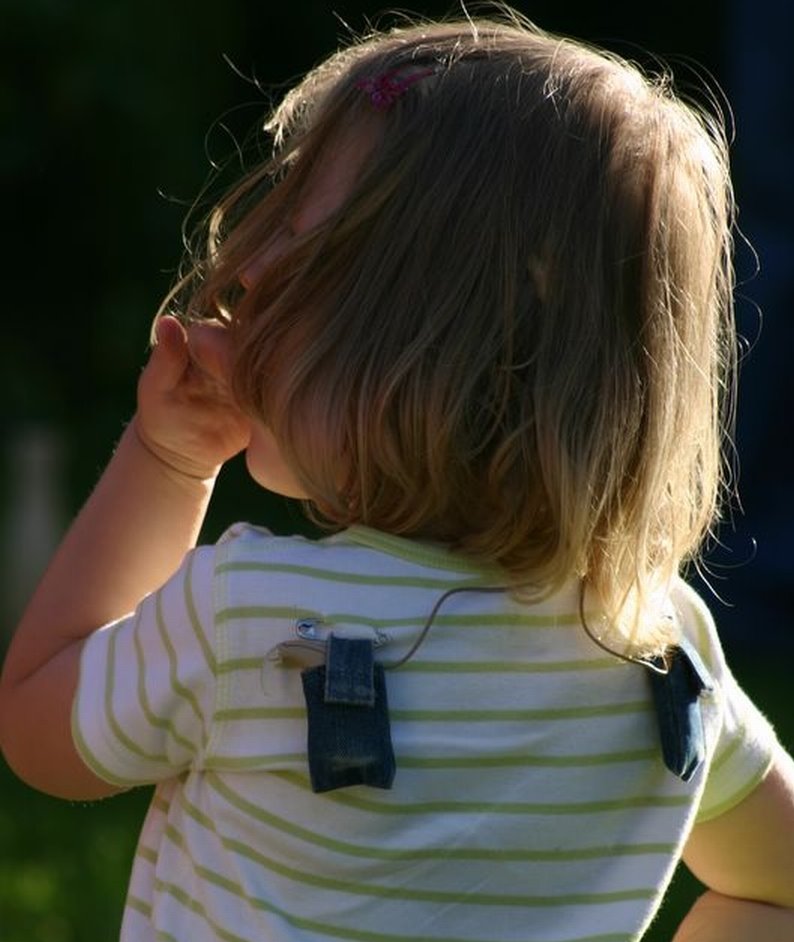
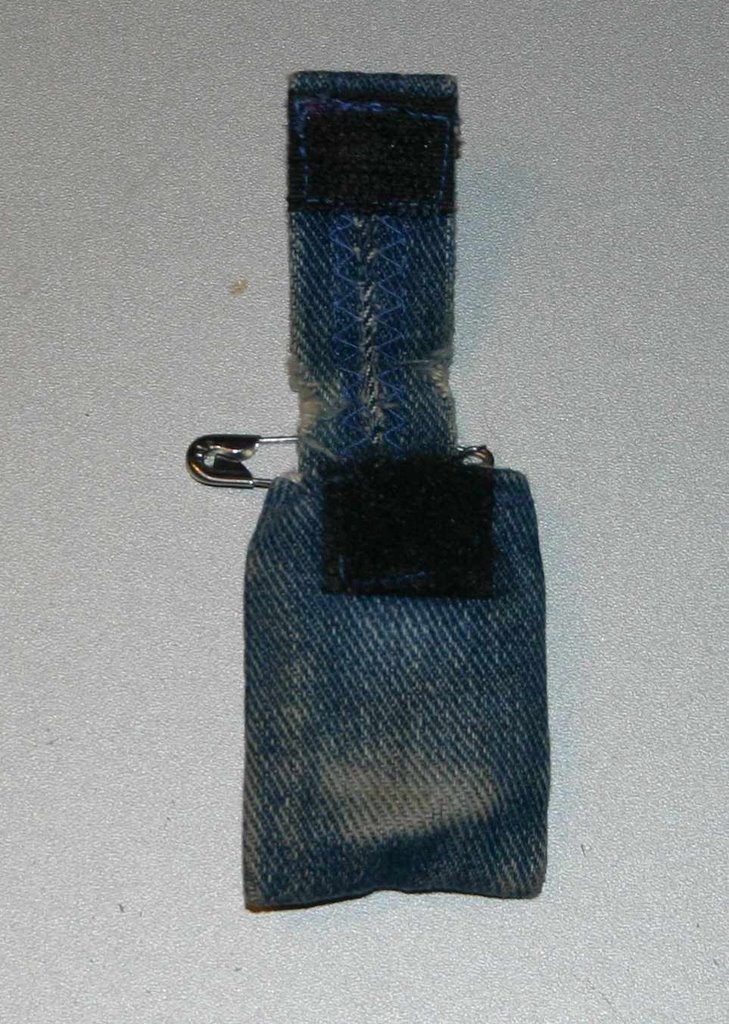
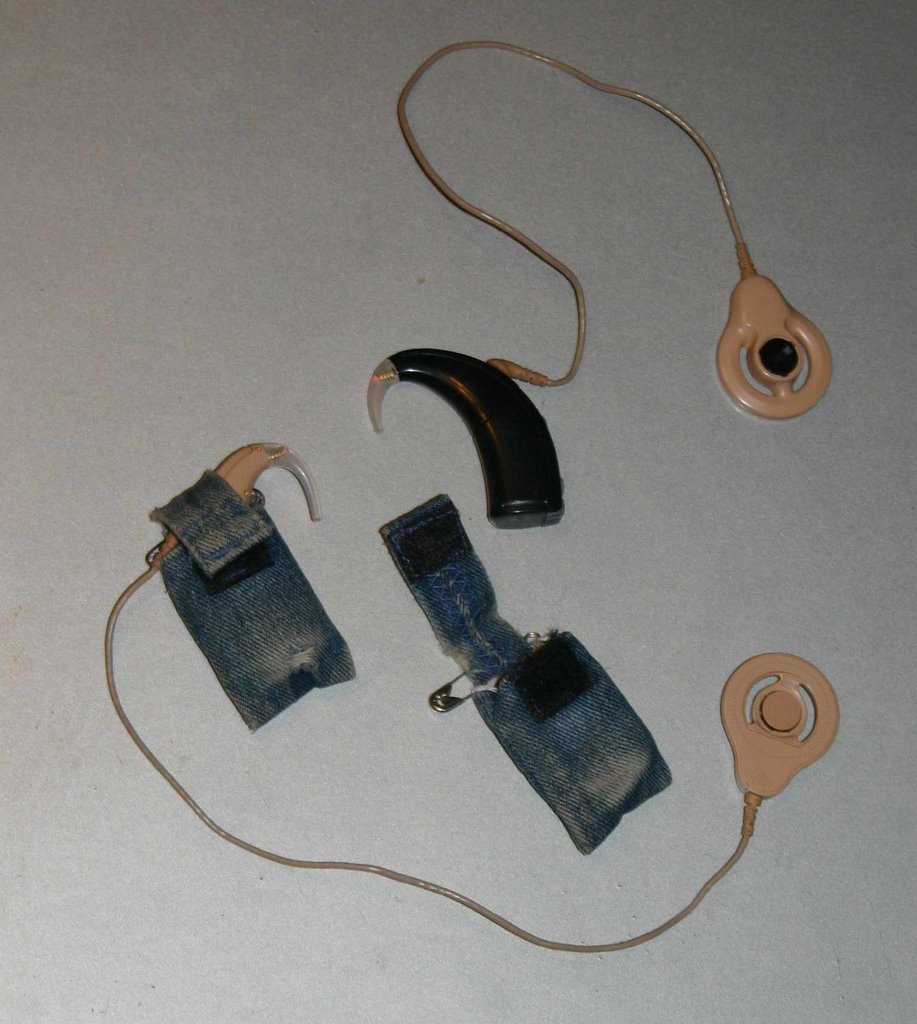
We very quickly chose to put them on her shoulders. At first I cut of fingers of a glove and attatched them with a safetypin. The providers of the Cochlear system - Medisan - quickly made sturdy bags, with a little flap that closed with velcro.


Another advantage of having the BTE's on the shoulder is that the BTE's don't show with the hair done up as shown here.... (Often we put the coil under the hair to make it harder to fall off.)


A couple of months ago, I sewed the safetypin on the bag. On the picture the flap of the bag goes through it. (Flap secures with velcro.) The microphone is sticking out.
As can be seen below, there is quite some wear on the bags, but for something used every day, 10-14 hours a day, they last quite long.

Some detail pictures of "our" system.... (Like with all pictures, just click to enlarge.)


(Here's some more info and comments in the blog regarding the BTE-bags.)

Friday, 15 September 2006

Overview of studies regarding bi-lateral CI

Here is the pdf:
http://www.bionicear.com/printables/reimbursement/BilateralCIBibliography-092006.pdf

Sunday, 15 May 2005

Benefits of bi-lateral

She once had one of her processors broken, and then she had CI on just 1 side. But this is already a big plus... she could still hear. Without bi-lateral CI, she would have been without sound.
In that time we noticed that with 1 CI she could not hear us as well. Noise was a real problem then, whereas with 2 CI's she has no problem following a conversation in the car or in the kitchen.
Also the sense of where sound comes from is helped with 2xCI. When hearing on 1 side, other senses and logic will determine where sound comes from. Bi-lateral CI will help a lot.

Regarding an additional operation.... I have seen children in Lottes school that got a second one after 1 to 2 years of CI. This means that in order to stimulate the new CI-side, the other side has to be disconnected. This can be really frustrating for these children. I'm really glad that Lotte got both sides at the same time, so we don't have that problem. But, realize that the additional benefit of a second CI is definitely there and I feel it is more than often suggested in articles and by the medical professionals.
BUT it is still small compared to the benefit of the first CI. THAT benefit is huge.

Saturday, 20 November 2004

Saturday, 9 October 2004

Emailed information

For those who we forgot to inform, two weeks ago we got the message that Lotte was going to be operated on monday 4th october.
We had to go to Oslo on friday in order to have her checked before the operation and there they informed us that they were offering to implant two cochlear implants instead of the usual one implant. So she will be able to hear with both ears!!!! She'll be able to hear where sound comesfrom, hear better in noisy environment and learning to speak might be easier as well. This was incredible. We thought about arranging for a second implant ourselves and then this offer comes along...

Operation on monday went extremely well. at 11:45 they were finished (started at 09:00) and shewoke up around 12:30. 15 minutes later she was doing puzzles. The artificial morfine they gave her meant nothing to her. She just kept on playing... and trying to remove the irritating line from her foot.
So back to the ward where she continued playing until she felt sick, threw up and started eating straight after it.
A paracetamol at 15:30 and after that it was just like normal. (This was the last painkiller she had.)
Except, she looks like Dopey - the dwarf from Snowwhite - with the ears standing out like they do. (The swelling is causing that, not the implants.)

So, we were running after Lotte monday-afternoon, tuesday the whole day and on wednesday we were allowed to travel back home.

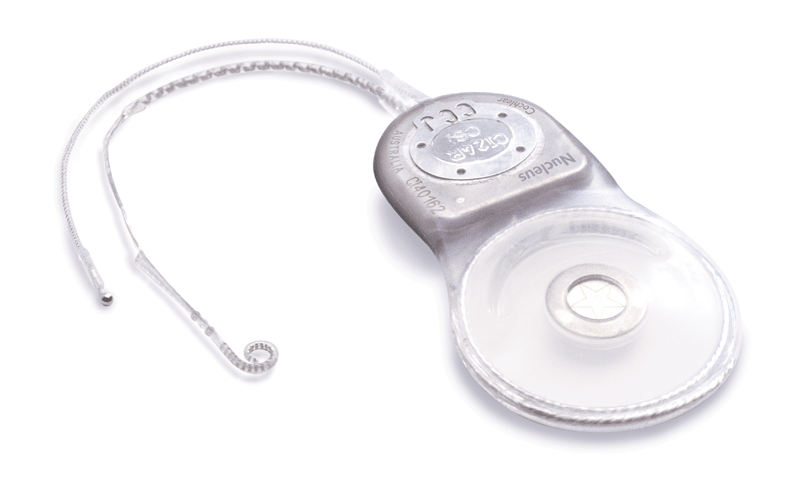
The external fitting of the equipment, and with that the first time she will perceive sound, will be done in November (22nd-25th) after the wound has healed and the implant has settled in the tissue behind her ear.The type of implant she got is the newest and finest of Cochlear, called Nucleus 4. (Correction - Renamed "Freedom") Even thought here is no information about this on the website of Cochlear (http://www.cochlear.com/) it looks almost the same as the Nucleus 3.

Friday, 1 October 2004

2004-10 (October) - Pre-Operation

The operation was scheduled in October 2004. 21 months after we discovered "officially" that she was deaf. She was 26 months old.

A preop/intake friday 1st of October, and the operation on the following monday, the 4th of October. We didn't stay in the hospital, but went home in between.


Finally - she was operated. And, as one of the first in Norway, she was offered bi-lateral Ci in 1 operation.... YES THANK YOU!!!!
We thought about that allready, and decided that in time we probably would do it.


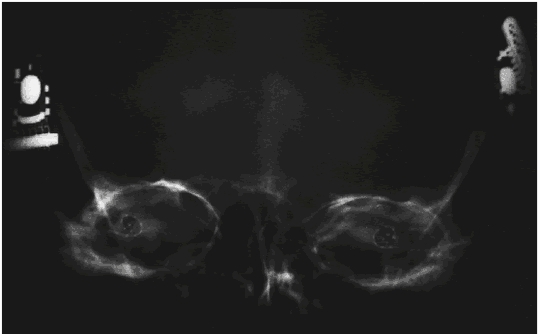
Here's a picture of an X-ray with bi-lateral CI. (Not Lotte) It gives a good impression about the size of the actual electrode..... (n.b. the big round circles are the eye-sockets. Behind there you can see the small spiral of the electrode.. )


Why would we want bi-lateral CI??

It's controversial because the idea is that the first CI is really a major improvement. The second one has less effect. The benefits are obviously that with bi-lateral CI one can hear where the sound comes from. Also, noisy environment is easier to handle because the brain can filter out a lot of the noise. This is obvious when listning through a phone. Noise on the other side is heared clearly while the person on the other side might not be bothered.
But in addition, when one CI fails, the other is still available.
Obviously, it will be two operations, but I don't believe it's double the risk. Another argument against might be that when CI is implanted in both ears, there is no option when new techniques arrive. (Stemcell for example)
But, if this would happen in 10 years, the auditory nerve would not have been used for 10 years, and who knows what the effect of that would be.

So, when we were offered bi-lateral CI in 1 operation, we gratefully accepted.

(Some) Milestones

  • 2013-08: Grade 6
  • 2012-08: Grade 5
  • 2011-08: Grade 4
  • 2011-03: BTE's on the ear
  • 2010-08: Grade 3
  • 2009-08: Grade 2
  • 2008-08: Mainstream School (6y. old)
  • 2006-10: All-hearing Kindergarten (4y. old)
  • 2004-11-22: CI activated (27 m. old)
  • 2004-10-04: Bi-lateral CI (26 m. old)
  • 2003-08: Deaf/HOH/CI Pre-school/"DEAF" Kindergarten (12m. old)
  • 2003-07: HA's fitted (11 m. old)
  • 2003-06: Diagnosed deaf. Start sign-language (10m. old)
  • 2002-11: Suspicion loss of hearing (4 m. old)
  • 2002-08: Born - A fierce LION
--- Google Analytics