Finished Matilda
Lotte finished Roald Dahl's "Matilda"..
 Up to the next one....
Like her brother and sister before her, she was hooked on it...


Milestones....
They happen all the time, and like I have said on the blog.. sometimes they fly by, and sometimes they stand up in your face... (well, I said something to that effect..)
 Last Thursday was the yearly checkup for Lotte. A great day out since we (actually, this was the first time I couldn't be there..) have to fly to Oslo, then take a train & tram to the hospital where the center for the check-up is located. One of Lotte's teachers joined Lotte and her mum.
This time, for the first time, it was Lotte who was in charge. She has grown so much lately, that my wife had no problem just sitting back and let Lotte do all the talking. And the specialists were excellent at directing everything to Lotte.
It must have been a wonderful day for Lotte because she was 100% focused the hole time. While adjusting the settings on the CI/BTE's, when finding the noises that she doesn't like (flushing the toilet) and trying to do something with that, she got it, and gave excellent feedback.. While doing speech tests in noisy environments and while doing comprehension tests. she did great. Her teacher was very impressed with Lotte..
But it's a great day out. She loves to go there and thrives on the attention, but this time, at the same time she realises the importance of the day.
In all, this day marks a beginning of Lotte taking over the "CI business" from us. She can accurately give feedback about how and what she hears. She understands the tests they are doing. She understands that there are different programs on her BTE she can use, because she was mentally there when they made them.
Of course life goes back to normal for her as soon as she was back at school, and she won't be playing with the different proframs, but she knows they are there.
Also, with one of her teachers being there, there is someone at school that will recognise difficult situations and can tell Lotte to switch to another program.. or, she might identify that Lotte forgot to switch back to the default setting.

A few days ago, while sitting at the kitchen table after school, Lotte put up a grave face and began to tell, "Mummy, today at school we learned about [......]". We could'nt understand the last word. Asked her to repeat it. "We learned about [.......] in the park behind our house. You have to stay on the path. If the children do not stay on the path and go walking in the woods, they can get killed".
?
Bombs. The [...] word was 'bombs'. This is one of those moments where as a parent you have to think FAST. Luckily, having read the newspaper the day before, we remembered suddenly that there was going to be huge campaign in Norway for land mine victims in Cambodia a few days later. We were able to explain to Lotte that this was in a different country, that there was no need for her to be afraid. At first she didn't believe us, because this was told at school! The ultimate truth...... But after a bit of persuasiveness it seemed like the best option to believe us. We also took contact with the teacher and explained what had happened.
This is a perpect example of how Lotte gives meaning to the parts and pieces of spoken language which she is able to pick up. It is like this giant puzzle with holes in it, where she needs to fill in the gaps in order for her to give meaning to the story. Needless to say, this is not always on par with reality. Even though we know this, we let ourselves get fooled again and again, because Lotte is excellent at hiding that she has not understood. No matter how well Lotte is doing, stories like these are essential to make us understand that we have to stay aware of this, and pay attention.
Imagine what this idea about bombs in our neighborhood could have meant for Lotte, if it had been allowed to develop in her head over time. Ever so glad she is the gabby, talkative type and wears her heart on her sleeve!!
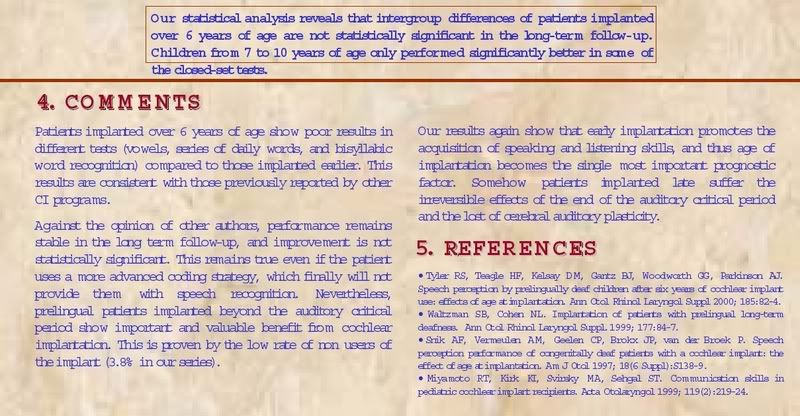
From a thesis by Carol A. Sammeth, Ph.D, CCC-A
Please be careful that the statements selected are representative of the paper's overall conclusions. Also, the part posted is only a piece of a longer work. (Full pdf here..)
------------------------------------------------------
BRIEF REVIEW OF BENEFITS OF TWO-EARED INPUT
The Psychoacoustic Literature
There is a fairly voluminous literature in psychoacoustics (hearing science) illustrating the benefits in normal hearing persons of having two-eared rather than one-eared input. When hearing loss disrupts the ability of the brain to process binaural inputs, whether due to large differences in the degree of loss between the ears, or a failure to provide amplification or a cochlear implant to one impaired ear, these benefits can be severely degraded or lost. There are three primary effects ascribed to binaural listening: the head shadow effect, the binaural summation effect, and the binaural squelch effect (e.g. Durlach & Colburn, 1978), producing benefits that range from improved speech recognition in noise, to the ability to localize the direction of a sound, to more “natural” perception. The following briefly describes the key benefits of binaural functioning.
Head Shadow Effect
When speech and noise come from different directions (i.e. are spatially separated, as typically occurs in the real world), there is always a more favorable signal-to-noise ratio (SNR) at one ear than at the other because of the head shadow effect and different sound distances to the ears. The head shadow effect is primarily seen in frequencies higher than 1500 Hz (e.g. Shaw, 1974), with the amount of attenuation of sounds from the opposite side of the head dependent on frequency but ranging from about 7 dB in the speech range up to 20 dB or more at the highest frequencies. If both ears are participatory, the ear with the most favorable SNR is always available so that the patient can selectively attend to this ear. This is compared to the unfavorable situation where only the ear with the poorer SNR is functional. Persons with unilateral hearing loss can become very frustrated when people are talking on both sides of them because they must constantly turn their “good ear” to whomever they want to hear best at the time, and then they miss sounds on the deaf ear side.
As will be shown later in this paper, a primary benefit of bilateral cochlear implants appears to be related to the beneficial aspects of hearing from both sides, and always having the ear with the more favorable SNR available. This is generally tested with speech from a frontal speaker and noise from a side speaker - - when the second ear is added that is contralateral to (opposite side of) the noise source, performance benefit comes primarily from the head shadow effect. Note, however, that there is discrepancy across the published studies in how to quantify the head shadow effect, with some researchers merely examining differences in scores with sound ipsilateral versus contralateral to a unilateral ear under test, and others comparing the score for listening with bilateral inputs to that for unilateral listening with the noise presented ipsilateral to the ear under test.
Binaural Summation & Redundancy
Sounds that are presented to both ears rather than just one are perceived as louder due to binaural summation of the information received at each ear. In fact, the threshold of hearing is known to improve by about 3 dB for binaural versus monaural presentation to normal ears, resulting in a doubling of perceptual loudness and improved sensitivity to fine differences in the intensity and frequency domains. This latter effect is sometimes referred to as binaural redundancy, and it is believed that it may translate into improved speech perception scores. When listening to speech with only one ear in a difficult listening situation or with one ear with greater sensorineural hearing impairment than the other, there is a loss of the redundancy in cues across the ears that may reduce performance.
The benefit of the binaural redundancy aspect of bilateral inputs is typically tested by presenting speech alone or having speech and noise emanate from the same loudspeaker frontally - - when the second ear is added, benefit is possible through redundancies or overlaps in representation at the two ears. In a normal hearing ear, this effect produces about a 1 to 2 dB improvement in SNR (Bronkhorst & Plomp, 1988). At this time, there is only limited evidence for true binaural redundancy effects on speech perception results in the
bilateral cochlear implant literature reviewed herein. This effect is probably not stronger either because such subtle cues are not able to be utilized by ears that have severe to profound hearing loss, or simply because the signal processing available in today’s cochlear implants (with two implants processing independently) does not adequately maintain these interaural cues.
Binaural loudness summation has been shown to occur, however, and is a potential confounding factor in comparing across studies. While most researchers have adjusted the loudness of the implant processing for binaural presentation versus monaural presentation (and made sure loudness is reasonably balanced across the ears), some have not. In a clinical bilateral implant fitting, it would generally be presumed that loudness would be adjusted so that the patient’s overall loudness comfort level is reasonable, and thus any purely binaural summation effects would be reduced or negated for bilateral listening compared to a previous unilateral implant.
Binaural Squelch/Unmasking
A person with only one functioning ear can usually understand conversation well when listening in a quiet environment, as long as the sounds of speech are made loud enough. However, even a normal hearing person who is listening in high levels of background noise can find speech understanding to be difficult in an adverse listening situation (consider, for example, competing conversations with multiple persons seated at a long table in a very high noise level restaurant). This occurs partly because of direct masking and partly because of upward spread of masking on the basilar membrane of the cochlea (whereby low-frequency sounds have a greater impact on reducing perception of higher-frequency sounds than vice versa). Speech recognition in such noisy environments is even harder for a person with sensorineural hearing loss both because of the inherent distortion and loss of normal nonlinearities introduced by cochlear damage, and because these patients show even greater amounts of upward spread of masking effects than do normal ears.
Fortunately, the auditory nervous system is wired to help in noisy situations as long as there is functional input from both ears - - that is, the auditory system and brain can combine information from both ears so that there is a better central representation than would be had with only information from one ear (e.g. Zurek, 1993). This effect, commonly referred to as binaural squelch (but also sometimes called binaural unmasking), results from the brainstem nuclei processing timing, amplitude, and spectral differences between the ears to provide a clearer separation of the speech and noise signals. The squelch effect takes advantage of the spatial separation of the signal source and the noise source(s) and the differences in time and intensity that these create at each ear. This is generally tested with speech from a front speaker and noise from a side speaker - - when the second ear is added that is ipsilateral to (same side as) the noise source, any benefit comes from the binaural squelch effect. There is some limited evidence of improved speech understanding in noise in bilateral cochlear implant patients due to binaural squelch effects, although the effect is not seen across all bilateral implant users or studies, and is not as large as the head shadow effect.
Note that binaural summation and squelch are signs of the ability of the auditory nervous system to integrate, fuse, and use information from the two ears. In contrast, the head shadow effect merely results from the physical attenuation of sound across the head and does not require central nervous system integration - - This does not negate the fact, however, that the head shadow effect is a substantial factor in everyday performance for those listeners with unilateral versus bilateral devices.
Localization
Finally, perhaps the most well-known practical binaural benefit is the ability to localize (i.e. determine the direction that a sound is coming from). This function is dependent on auditory Bimodal Devices and Bilateral CIs, page 9 system perception of interaural (between ear) differences in time, intensity, and phase (e.g. Yost & Dye, 1997). Localization ability can be a safety consideration. For example, when crossing a busy street, it is important to know the direction that a car is coming from. Persons with significant unilateral hearing impairment can also attest to the frustration of hearing their name spoken but not knowing which direction to turn in order to find the person calling them.
Research to date has focused on localization of sound sources in the horizontal azimuth, but keep in mind that it is also possible for a listener to differentiate sound sources in the vertical plane (by elevation) and in terms of the distance from the listener. It is well known that interaural timing differences provide the information necessary to locate the direction of low frequency sounds - - specifically, those less than about 1500 Hz. For sounds that are higher in frequency, the main cue for horizontal plane localization is the interaural intensity difference that occurs because of the head shadow effect. In addition, head and pinna shadow effects,
pinna filtering effects, and torso absorption properties can all contribute to spectral differences that can be particularly helpful in determining elevation of a sound. For a listener with only one functional ear, there are very few cues to assist in sound localization although some rudimentary localization ability can still exist. The literature on bilateral cochlear implants provides significant and substantial evidence that localization abilities are enhanced with the use of both ears versus just one.
As shown earlier in the blog, Lotte loves to dance and sing. Together with her sister, they have given quite a few performances.. (See here for example.) A friend of us teaches jazz and ballet at the local music-/culture- school... and when we asked if Lotte could have a look one day she was very happy to invite Lotte.
Our experience before with these kind of activities - before she went to school - was that she is very shy entering an unknown group and joining. Difficult for her to understand what's happening...
Bought the required clothes to make sure Lotte would feel like part of the group, and little ballet shoes. All very much to Lotte's taste.. After all, dressing up is one of her favorite activities. So, with mixed feelings and not-too-high expectations Lotte and her mom went to the class.
And there the miracle started.....
No problem getting into the classroom. She felt totally at ease, as if she had been there before. No problem that there were 7 other 6-year old girls there that she didn't know. She chatted with the teacher (who - as mentioned she knows a bit ) telling her what happened at school. But she was there to dance, and that's what was going to happen.
She understood the instructions, and was very able to do it.. Looking at what the other children did helped as well.. Total commitment, whilst carrying a radiant smile on her face!!
The teacher, our friend, is English but speaking mainly Norwegian to the class... Suddenly there was counting in English... and Lotte understood that as well.. (Has had it at school..) and when some colors were mentioned Lotte got in the discussion with mentioning "Pink"... in English...
So... understanding the context and not afraid to put in a word herself. The class went extremely well.. Lotte floating on a cloud due to dancing.. Totally in her element.. It is wonderful to see how she as grown. Getting confidence in herself and the outside world.
Without CI it would have been impossible to do this to the level she is doing it now.
The way she feels secure, and is totally open for new challenges. The way she claims part of the world.
She was still on cloud 5 when going to bed...
.... techniques.... She has so many of them.
Lipreading is well-established, but I have a feeling there's not that much relying on it. She hears well and is more able to understand sentences... Without CI on she will use it, and will still amaze us with how well she can lipread.
 Last week I saw another survival technique that we know for long, and avoid automatically..
The speech therapist asked Lotte this question "Lotte, after school, do you go home by yourself, or will daddy or mommy pick you up.?"
Alarm-bells rang with me... Too long a sentence.... Lotte wouldn't get it.. I kept quiet.. since Lotte sometimes has a way to surprise us.
Lotte looked as if she was thinking..... and then said "Yes".
The speech-therapist interpreted the answer... "So your walk home alone".... and Lotte said "Yes".
She really didn't get the question. It was too long, too complicated, so by answering "Yes" she made the adult happy, and as far as Lotte goes she got the right answer. (btw... It was the wrong answer, she never walks home alone.)
But it shows how she sometimes survives.. and people should be careful with how they ask questions...
Sort of the same in the classroom. The teachers are very good and Lotte is doing very well. They look at the children when they speak (Not to the blackboard) and there are more things that help Lotte. And the rest of the class.
One is that a message given to the class, is repeated to Lotte. To make sure she understands what's ahead.
Normally, Lotte will closely look at the other children and figure out what to do, but sometimes extra guidance is needed.
I told them that they should NOT repeat the message to Lotte personally. In no time she will ignore the first message to the classroom. After all, why bother when you know it's going to be repeated just for you.
I suggested to the teacher that she would not repeat it, but that she would ask Lotte what just had been said. That way Lotte will focus on the first message in order to make sure she can repeat what has been said..
In all, these survival skills are OK. I guess we use them as well at times...
But for Lotte it's important that she learns to listen well... So, at times we let it slip, being aware how much she does and does not understand, at times we make sure that she gets it.
But also the people around her should be aware of all of Lotte's survival skills..
Lotte is doing very well at school. She enjoys going there, staying there. Dropping her off does not require any more crying from her side. She happily goes in by herself.... "Bye-bye mummy.!" to indicate that she goes into the classroom. Progress!

Today another change in time became clear. It is not that Lotte and her sister quarrel a lot, because they don't. But whereas before the reason for quarrelling mainly would be because of misunderstanding or lack of communication, we now see (or more accurately: hear) a shift to quarrelling because of Lotte becoming more and more able to be verbally argumentativ.
I'm virtually allergic to hear my kids quarrel, but in this case it's like music to my ears!
Mous

I enjoy quotes. They give quick insight in certain subjects. Lotte's mother is currently studying Special Education (Not sure if that is the corect translation for "Spesial Pedagogik" - will correct it later..) and with the papers she has to write, quotes actually give good starting points.
Here are a couple we found... Of great interest are the ones from long LONG time ago. The filosphers of the old days - gnostics - regarded language and debate very important.....
Neither can embellishments of language be found without arrangement and expression of thoughts, nor can thoughts be made to shine without the light of language.
One of the most important things to do with children is to read to them.
It will give them a feeling for words, for rhytm, rhyme, pronounciation etc. There's a direct link between the amount of reading a child gets (read to or reading themselves) and the performance at school.
 Today Lotte's mum was reading from the "Mijn eerste Van Dale", a book with rhymes for little children, going through the whole ABC...
Lotte loves to do this. Loves to learn new words.
 The book is obviously for all 3 children, but for the others we also bought the "Junior Spreekwoordenboek" a dictionairy with uhh. (cannot recall the english word.....) proverbs. (Thanks to this website)
It's great for them. Stimulates them to read, search for info elsewhere than on the internet.
They love it and read with grandma (who's staying with us), learning all kinds of new proverbs.
 In addition... (the ease of the internet allows you to click on yet another item to buy) we bought the "Van Dale Praktijkgids voor Spelling". Not living in Holland, we have to make sure the kids can write proper Dutch.
Yesterday, saturdag, lying in bed, sleeping in.... suddenly a knock on the door.
Lotte, getting bored watching TV with her brother and sister, insisted on chatting with us.
And there was lot's to chat about. Not going to the kindergarten, grandma coming today, after the theater-play, etc.
So she's chatting away, explaining about stuff... most we understand.
But then, when I tried to say something to her, the reply I got was "Quiet, daddy.... I'm talking to mommy"!!!
Well, there's the prelude to "shut up" for you.....
But we had to laugh soo hard, and Lotte with us. She loves the attention and is happy to play the act..
One of Lotte's best friends, Tone, visited her at her kindergarten. Tone was Lotte's speech therapist for 2 years in the "deaf" preschool/kindergarten and they really bonded. Then she started working elsewhere, and Lotte went to the new kindergarten.
We still have good contact since we all became good friends. Also, she now works close to the university, where Marieke now studies.
In her new job, Tone is still connected to Lotte, but in another setting.
This allows her to get involved, and this happened last week.
Lotte was allready informed and she was very excited to see Tone.
Tone lead a "gathering" where all the children are together and everyone is involved.
She explained sign, the colours, and as allways, the children loved it. (I still have to meet a child that is not entrigued by sign) She used sign throughout the whole gathering.
And this showed the gap between Lotte and the rest of the children.
Lotte was 100% focused and got everything. This is not the case when only spech is used. She still has to get more exposure so in a normal gathering she loses focus quickly due to the lack of understanding. Not when sign is used together with speech.
In a know situation she will be fine. When it's lunchtime, she knows the routine and has more control over what's happening. Outside these standard situations she will be less secure because she will have more problems understanding what's going on.
The "problem" is likely to be due to a lack of understanding speech, but a large part is comprehension. She does not have the capacity to think like a 4-5 year old child.
But it will come. With speech the comprehension will follow.